
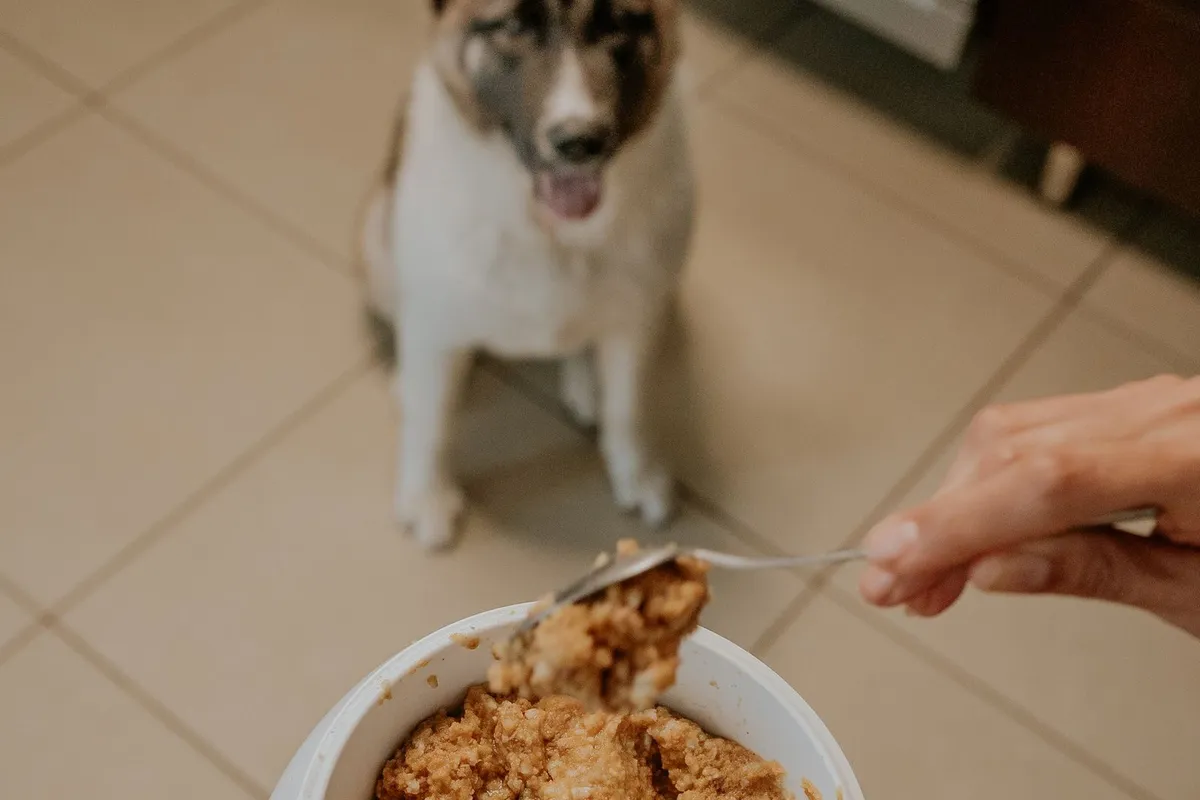
Homemade Dog Food for Senior Dogs (2026): ChefPaw vs Balance It vs a Nutritionist
By Sarah Bennett · Last updated September 2, 2026 · 11 min read
The short version: Homemade dog food for senior dogs can work well, and for a picky twelve-year-old who has started turning her head away from the bowl, it is sometimes the thing that gets her eating again. What decides whether it works is not the recipe. It is whether anyone balanced the nutrients. Three routes get you a genuinely complete bowl: a board-certified veterinary nutritionist, a formulation service like Balance It, or a machine-plus-app system like ChefPaw. A fourth route, cooking chicken and rice from something you found online, is the one that quietly causes harm, and it is the one most people take.
Our Ratings at a Glance
Some picks below are affiliate links. If you buy through one, we may earn a small commission at no extra cost to you. It never affects our ratings.
1
Balance It Canine supplement plus free Recipe Builder4.5 / 5Best route for most owners cooking at home
- Recipe Builder is free and self-service
- Supplement powder: $85.32 for 600 g, $8.88 for a single 20 g pouch
- Founded by a board-certified veterinary nutritionist
- Dogs with a diagnosed condition need vet sign-off first, per FDA guidance
2
ChefPaw Dog Food Maker (Model C-PRO)3.5 / 5Best for owners who will not stick with cooking any other way
- $549 for the C-PRO, or $599 bundled with the Vitality Pack supplement
- About 6.4 lbs (3 L) per batch in roughly 40 minutes
- App checks a recipe against your dog's profile; included with the machine
- Completeness depends on adding the supplement every batch
I started looking into this the way most owners do. Lucy went through a stretch of picking at her food, and standing at the stove with a pan of plain chicken felt like the obvious kindness. It took about an hour of reading to understand that the kind version and the safe version are not automatically the same meal.
Is Homemade Dog Food for Senior Dogs Actually Better?
For palatability, often yes. Warm, soft, strong-smelling food is easier for an older dog to want, and appetite is one of the first things to slip in a senior. If your dog has stopped eating her usual food, fresh food is a real lever.
For nutrition, "better" is the wrong frame. A home-cooked bowl is fresher and you control every ingredient, and neither of those things makes it complete. Commercial food is boring precisely because it is engineered to hit a nutrient profile in every bag. When you cook, that engineering has to come from somewhere else, or it does not happen at all.
So the answer to is homemade dog food better for senior dogs is that it is better at the things you can see and worse at the things you cannot, unless you deliberately fix the part you cannot see.
What Actually Goes Wrong With Home-Prepared Recipes
The research here is unusually blunt, and the numbers say more than any summary of them.
A 2017 analysis in the Journal of Nutritional Science (full text) evaluated 106 published home-prepared recipes, 80 of them for dogs, against FEDIAF maintenance recommendations. The finding: "All diets had at least one nutrient below the recommendations," and every nutrient the authors examined was deficient in at least one recipe. Among the dog recipes, the most common shortfalls were copper (85.4%), choline (85.4%), vitamin E (82.9%), zinc (75.6%), calcium (73.2%), iron (68.3%), riboflavin (65.8%), and vitamin B12 (61%). The authors also noted that "Most recipes (48 %) had no precise determination of ingredients and quantities."
Two things in that list deserve a senior owner's attention. Calcium missing from three-quarters of recipes matters most in a dog whose skeleton is already carrying arthritis. And these were published recipes, many written by professionals. The ones circulating in breed forums are not held to a higher standard.
A separate evaluation of home-prepared recipes for dogs and cats with chronic kidney disease found that none met all National Research Council allowances, which is why our guide to feeding a senior dog with kidney disease treats homemade as a nutritionist's job rather than a weekend project.
What goes wrong is almost never protein or calories. It is the trace minerals and vitamins that no ingredient list makes obvious, accumulating quietly over months.
What a Senior Dog Needs That a Generic Recipe Misses
Three adjustments matter more with age, and generic recipes rarely make any of them.
Protein should hold or rise rather than fall. The 2023 AAHA Senior Care Guidelines recommend that healthy senior dogs maintain or increase protein intake to protect against age-related muscle loss. The old advice to cut protein in older dogs has been corrected, but plenty of homemade recipes are still built around the older idea, padding the bowl with rice.
Calories usually need to come down while nutrients stay up. An older dog moving less needs a denser nutrient profile in a smaller volume, which is exactly the balancing act a recipe written for "dogs" does not attempt.
A diagnosis changes the arithmetic entirely. Kidney disease makes phosphorus the governing number. Pancreatitis makes fat. Heart disease makes sodium. A recipe that is complete for a healthy nine-year-old can be actively wrong for a dog with a diagnosis, and most senior dogs have one.
That last point is why the routes below are ordered the way they are.
The Three Routes That Produce a Complete Bowl
Route 1: A board-certified veterinary nutritionist (DACVN)
The gold standard, and the only route that starts from your dog's bloodwork rather than from a template. A nutritionist formulates for the specific dog, the specific diagnosis, and the specific medication list. You pay a consultation fee and you get a recipe nobody else has.
This is the right route if your dog has kidney disease, a heart condition, pancreatitis, or two diagnoses interacting. It is overkill for a healthy senior whose only problem is that she has gotten bored of kibble.
Route 2: Balance It (formulation service plus supplement)
Balance It was founded by a board-certified veterinary nutritionist and sells a vitamin, mineral, and amino acid powder designed to fortify home-cooked recipes. Its Recipe Builder generates a recipe from ingredients you choose and tells you how much supplement to add.
The software is genuinely free. In the company's words (balance.it/faqs), it "is and remains completely free, and intentionally self-service." For a healthy dog the path is immediate: "If you have a healthy adult dog or cat, you can use the Recipe Builder."
If your dog has a diagnosis, the free path has a gate on it, and that gate is not mentioned on the homepage. Balance It states (balance.it/faqs) that "If your animal companion has a medical condition under a veterinarian's care, you will be required per the FDA (CPG Sec. 690.150) to submit a veterinary approval request before you can view a nutritionally complete recipe made with our free custom Recipe Builder." They contact your vet on your behalf, and they add that "We do not charge for this service, but your veterinarian may need to charge you a fee to cover their effort/time."
For the arthritic, kidney-monitored, thyroid-medicated dogs who make up most of the senior population, free and instant turns into free plus a few business days plus whatever your vet charges to sign. That is still inexpensive. It is worth knowing before you plan Sunday's cooking.
Cost of the supplement itself, at the time of writing: $85.32 for a 600 g bag, $60.25 for 200 g, and $8.88 for a single 20 g pouch if you want to try it before committing. These are the vet approved homemade dog food recipes route for most healthy seniors: not a printed recipe at all, but a formulation tool plus the powder that closes the gaps.
Route 3: ChefPaw (machine plus app)
ChefPaw sells a countertop appliance that mixes and cooks a batch of dog food, paired with an app that builds recipes and tracks their nutrient content. The company (chefpaw.com) describes the batch as "approximately 3 liters (6+ lbs) of perfectly mixed and uniformly cooked pet food" in about 40 minutes, and the product page lists the C-PRO model at $549.00, or $599.00 bundled with its Vitality Pack supplement. App access is included with the machine. Refurbished units are listed from $199 to $399.
What you are buying is adherence. Most people who try home cooking quit, and they quit over the labor: the chopping, the pans, the portioning, the freezer bags. A machine that finishes a batch in 40 minutes with one bowl to wash removes the reason people quit. That is not a small thing, and an honest ChefPaw review should say so before it says anything else.
What Is Actually Inside the $10 ChefPaw App
There is a third option between the machine and nothing, and it is easy to miss because it sits on a separate product page. ChefPaw sells app access on its own for $10 a month, aimed at people who "do not own the ChefPaw Pet Food Maker Model C-PRO". Machine owners already have it; there is no reason for them to pay twice. The app itself is a free download on the App Store, where the subscription is the paywall behind it.
What you get, in the company's own description, is the ability to "create pet profiles, browse nutritionally formulated recipes, view detailed nutrition data, follow step-by-step cooking instructions, build grocery lists, and apply recipes to your dog's profile for serving guidance." In practice that breaks into five things:
| What it does | What that means in use |
|---|---|
| Pet profile | You enter age, weight, activity level, body condition, and ingredients to avoid. Everything else keys off this |
| Recipe library | Browsable by category, including senior-focused, allergy-friendly, and small-dog sets. Each recipe carries amounts, steps, and nutrient data |
| Nutrition analysis | The App Store listing says the app analyzes 60+ nutrient data points against your dog's daily needs, which is the part a paper recipe cannot do |
| Serving size | Applies a recipe to your dog's profile and calculates the portion, rather than leaving you to work out grams from a photo |
| Cook Now and grocery lists | Step-by-step guidance through a batch, and a shopping list before it |
The nutrition analysis is the piece that matters for this article's argument. ChefPaw's FAQ places the supplementation instructions inside the app rather than on the box: "For nutritionally complete homemade feeding, follow the appropriate ChefPaw recipe and supplementation guidance provided through the ChefPaw Nutrition App." So the app is where completeness actually lives. That is a point in its favor and a reason not to treat the subscription as an optional extra if you own the machine, though machine owners get it anyway.
Why $10 a Month Does Not Replace the $549 Machine
Read the product page carefully and it tells you something the price does not. ChefPaw's recipes are built around one-pot cooking in their appliance, and the company says plainly that they "may not translate directly to traditional stovetop, oven, or multi-step cooking methods," because "Cooking times, moisture levels, ingredient texture, and nutrient retention can vary depending on the appliance and method used." The same page states that "recipes are best prepared with the" ChefPaw machine.
That is the honest boundary on this subscription. Ten dollars a month does not buy you a way to cook ChefPaw meals on your stove; the Cook Now walkthrough is written for the machine, and the recipes are calibrated for it. What the subscription buys is a look inside the system before you spend $549: whether the recipe library actually covers your dog, whether the serving guidance makes sense to you, whether the whole approach fits how your household cooks.
Judged that way it is reasonably priced, and judged as a cheaper substitute for the machine it is not the thing it appears to be.
One more caution about the app as a nutrition tool. Its own page says the recipes and nutrition tools "are not a substitute for veterinary advice" and directs owners of dogs with medical conditions or therapeutic diet needs to a veterinarian first, which is the same boundary this whole article keeps running into: software can balance a recipe, and it cannot know your dog's most recent bloodwork.
If what you want is recipes and a nutrient readout rather than a preview of the machine, Balance It's Recipe Builder does that job for nothing, and paying monthly for it is hard to justify.
Worth knowing before you judge the app by its rating: at the time of writing the App Store listing showed a 5.0 average from two ratings, both of them five stars, which is a sample too small to mean anything in either direction.
What you are not buying is nutritional authority, which brings us to the claim on the box.
What ChefPaw's AAFCO Claim Does and Does Not Mean
ChefPaw's FAQ (chefpaw.com/pages/faq) says: "Yes, all ChefPaw recipes are formulated to meet or exceed AAFCO nutritional standards." Its homepage puts the claim next to the app in a single sentence: "ChefPaw recipes are formulated to meet or exceed AAFCO nutritional standards, and the ChefPaw Nutrition App helps guide you through recipes, ingredient amounts, portions, and your dog's nutritional needs." Note where the second half of that sentence sends you.
Two sentences on the same site draw the right boundary around all of that. The first is from the FAQ, on what a complete bowl actually requires: "For nutritionally complete homemade feeding, follow the appropriate ChefPaw recipe and supplementation guidance provided through the ChefPaw Nutrition App." The same page repeats the instruction: "Always follow the supplementation instructions for the specific ChefPaw recipe you are preparing." The second is the company's own limit on custom work for sick animals, which it says has to come from a licensed veterinarian.
Read together, those statements are consistent, and they are more forthcoming than most of this category. They also mean something specific that a buyer should hold onto: the completeness lives in the supplement scoop rather than in the machine. The appliance mixes and cooks. Whether Tuesday's batch meets a nutrient profile depends on whether you added the right supplement in the right amount, every time, including the week you are tired and the week you run out and decide one batch without it will not matter.
That is a different risk from the one the research above describes. The failure lives in the distance between a system that works when followed and a person following it for two years, rather than in any ignorance of the nutrient gaps.
I have not cooked with a ChefPaw. I have read its documentation closely, which is what the scores in this article rest on, and I would rather say that plainly than imply a kitchen test I did not run.
How Much Does Homemade Dog Food Cost?
Ingredients are the recurring cost in every route, and they vary too much by region for a national number to mean anything. What I can put side by side is the entry cost and where the balancing comes from.
| Nutritionist (DACVN) | Balance It | ChefPaw | |
|---|---|---|---|
| Up-front | Consultation fee | $0 for the recipe | $549 (C-PRO), $599 with supplement |
| Recurring | Ingredients, plus rechecks | Ingredients plus $85.32 per 600 g | Ingredients plus supplement |
| Who balanced it | A board-certified nutritionist, for your dog | Software from a nutritionist-founded company | Recipes developed with veterinary nutritionists |
| Handles a diagnosis | Yes, that is the point | Only after a vet approval request | Company says medical recipes need a vet |
| Labor per batch | You cook | You cook | Machine, roughly 40 minutes |
| Fails when | You stop rechecking as disease progresses | You skip or eyeball the supplement | You skip or eyeball the supplement |
The bottom row is the one to sit with. Two of the three routes fail the same way, and it is not a failure of information.
Balance It vs ChefPaw: Which One Fits Your Dog
Choose Balance It if your dog is reasonably healthy, you already cook, and you want the cheapest path to a bowl that is genuinely complete. You are paying about $85 and doing the work yourself.
Choose ChefPaw if you have tried home cooking and stopped, and you know yourself well enough to admit the labor is why. $549 is a lot of money for a mixing bowl with a heater, and it is also a lot less than a diet you abandon in six weeks. If you are not sure that describes you, the $10 app subscription is the cheap way to find out before the machine.
Choose a nutritionist if your dog has a diagnosis that moves the target numbers. No app is formulating around your dog's most recent creatinine.
Choose none of them and stay with a good commercial food if the honest answer is that you will not do this consistently. A complete commercial diet beats an inconsistent homemade one, and there is no shame in that trade. Our guide to the best senior dog food covers what to look for, and fresh delivered food sits in between if palatability is the actual problem.
Frequently Asked Questions
Is homemade dog food better for senior dogs than kibble? It is usually more palatable, which matters if your dog has lost interest in food. It is not automatically more complete. A 2017 analysis found every one of 106 home-prepared recipes fell short on at least one nutrient. Fresher does not mean balanced.
Are there vet approved homemade dog food recipes for senior dogs? Yes, though "vet approved" is doing a lot of work in that phrase. A recipe formulated by a board-certified veterinary nutritionist for your specific dog is one thing. A blog recipe with a veterinarian's name on it is another, and the 2017 study included recipes written by professionals among those that fell short. Ask who formulated it and against which standard.
How much does homemade dog food cost? The formulation and supplement layer runs from free (Balance It's Recipe Builder) to $85.32 for a 600 g supplement bag to a consultation fee for a nutritionist, with ChefPaw's appliance at $549. Ingredients are the larger recurring cost in every case and depend on what you buy.
Can I just cook chicken and rice for my senior dog? For a few days during a stomach upset, on your vet's advice, that is a normal short-term measure. As a long-term diet it is one of the clearest paths to the deficiencies described above, particularly calcium, copper, and zinc. Short-term bland food and a long-term diet are different jobs.
Does my dog's diagnosis change the answer? Substantially. Kidney disease makes phosphorus the governing number, pancreatitis makes fat, heart disease makes sodium. If your dog has a diagnosis, start with your vet or a nutritionist rather than with a recipe, and read our kidney disease diet guide if that is the diagnosis in question.
Is homemade food safer than commercial food? Not inherently. You avoid recall risk and you gain ingredient control, and you take on the entire burden of nutritional completeness plus food-safety handling of raw meat in your own kitchen. It trades one set of risks for another.
Sources
- Pedrinelli V, Gomes MOS, Carciofi AC. Analysis of recipes of home-prepared diets for dogs and cats published in Portuguese. Journal of Nutritional Science 2017;6:e33. doi.org/10.1017/jns.2017.31
- Larsen JA, Parks EM, Heinze CR, Fascetti AJ. Evaluation of recipes for home-prepared diets for dogs and cats with chronic kidney disease. JAVMA 2012;240(5):532-538. PMID 22332622
- Balance It, Frequently Asked Questions (Recipe Builder access, veterinary approval requests, fees). balance.it/faqs
- Balance It Canine product listing (supplement sizes and prices). shop.balance.it
- ChefPaw, Frequently Asked Questions (AAFCO statement, supplementation, recipe development). chefpaw.com/pages/faq
- ChefPaw, product and nutrition claims (batch size, cooking time, 68-nutrient app, C-PRO pricing). chefpaw.com
- 2023 AAHA Senior Care Guidelines for Dogs and Cats (protein for healthy seniors). aaha.org
Prices were checked on August 25, 2026 and change without notice. Confirm on the seller's site before buying.
Keep Reading
- Best Senior Dog Food, what to look for on the label if you stay with commercial food
- Best Dog Food for Senior Dogs With Kidney Disease, where homemade needs a nutritionist
- Fresh Dog Food vs Kibble, the middle option if palatability is the real problem
- Senior Dog Won't Eat, the appetite question that sends most owners to the stove in the first place
About the author
Sarah Bennett writes about senior dog care from a household centered on her Border Collie Lucy. This comparison was built from the companies' own published documentation and from the peer-reviewed evaluations of home-prepared recipes cited above. She is not a veterinarian. The scores here come from each company's published specifications and from the peer-reviewed evaluations of home-prepared recipes cited above. If your senior dog has a diagnosed condition, the recipe conversation belongs with your vet or a board-certified veterinary nutritionist before it belongs with an app.