How to Trim Senior Dog Nails Without the Struggle
By Sarah Bennett · Last updated August 13, 2026 · 10 min read
I write as a researcher and owner, not a veterinarian. If your senior dog's nails are severely overgrown, curling into the pad, or she is in pain when you handle her paws, have your vet or a groomer take the first pass rather than working it out at home.
The short version: For an older dog, nail length is not just grooming, it is mobility. Long nails distort how her paws sit on the floor, push her into a compensating posture, and add strain to joints that may already be arthritic. The safe way to trim senior dog nails is small and often: take a little off each nail, learn to find the quick (the blood vessel inside), keep styptic powder within reach in case you nick it, and stop before you reach it. If the nails are badly overgrown, the quick has grown out with them, and shortening safely takes weeks of frequent small trims, not one big cut. Go slow, make it calm, and get help for the paws you cannot read.
Trimming an old dog's nails is one of those small jobs that quietly gets harder with age, for both of you. She is stiffer and less patient about having a paw held, her nails are often thicker and darker, and the stakes are higher, because a senior dog feels a bad trim, or overgrown nails, more than a young one does. The good news is that the technique is learnable, and getting it right does more for a senior than most owners realize.
Why nail length matters more for a senior dog
It helps to understand this before you pick up the clippers. A dog's toes are packed with sensors. As Dr. Julie Buzby explains, the toes carry an abundance of proprioceptive receptors that tell the brain where the body is in space, and long nails send that system faulty data, which shows up as poor posture and an altered gait.
Picture what a too-long nail actually does. When the nail hits the floor before the paw is flat, the dog cannot stand with her legs squarely under her. She compensates, shifting her weight and changing her stance to keep from tipping forward, and she holds that compensating posture all day. Over time those chronic, abnormal forces load the joints, tendons, and ligaments in ways they were not built for. The American Kennel Club describes the same mechanics from the paw up: a long nail striking the ground splays the foot, reduces traction, and puts force on the foot and leg structure.
For a young dog that is a slow, background problem. For a senior, it lands on top of joints that are often already sore. If your dog has arthritis, overgrown nails are quietly working against every other thing you do to keep her comfortable, from her orthopedic bed to her at-home arthritis care. Short nails will not cure her stiffness, but they remove a strain you can actually control.
How to trim senior dog nails, step by step
The method that works for an older dog is calm, slow, and forgiving.
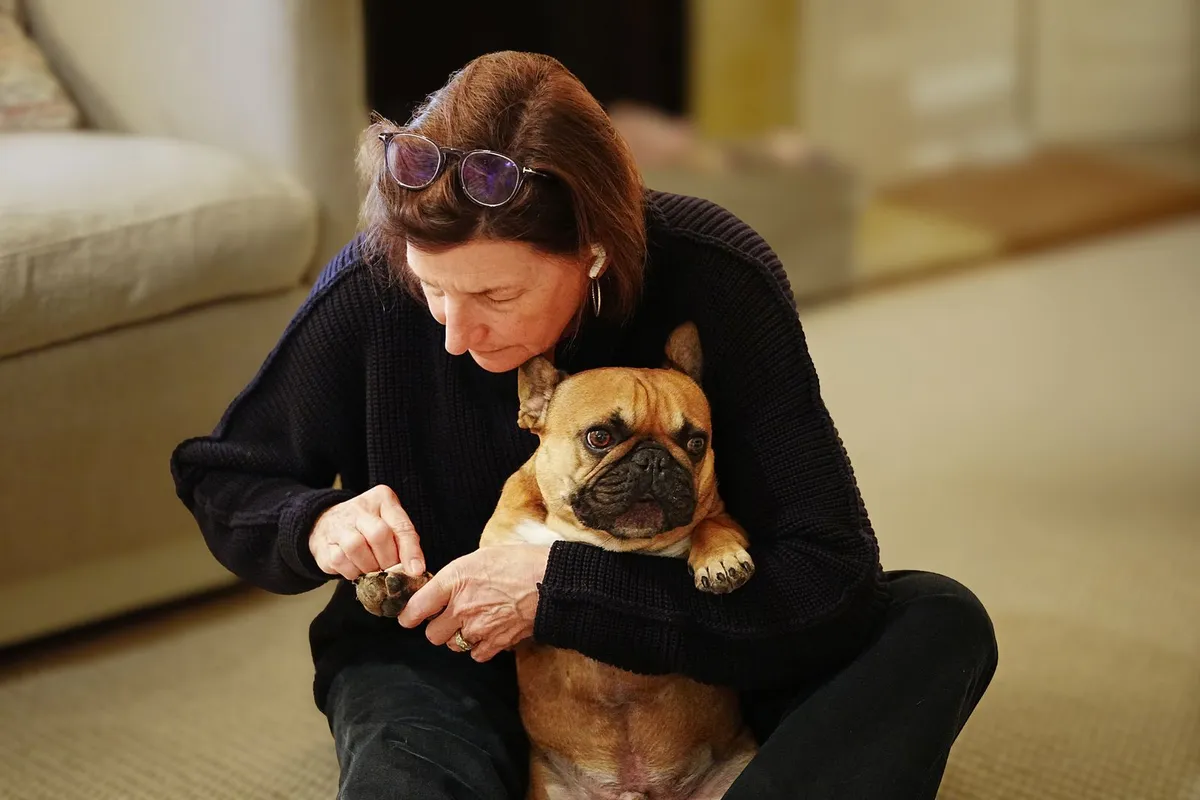
- Get her comfortable first. A stiff senior should not be wrestled into an awkward position. Let her lie on her side on her bed, or sit while you work from beside her rather than looming over her. Support the joint, do not crank the leg into a stretch.
- Work one paw at a time, and take breaks. You do not have to finish all four feet in one sitting. For a nervous or arthritic dog, two nails and a treat is a fine session.
- Find the quick before you cut. The quick is the living core of the nail, with a blood vessel and nerve. On a light nail you can see it as the pink line inside; stop a couple of millimeters short of it. On a dark nail you cannot see it, so shave off thin slivers and watch the cut end: a black dot appearing in the center of the pale cut surface means you are close to the quick and should stop.
- Cut small, at a slight angle, following the natural shape of the nail rather than lopping straight across.
- Keep styptic powder within reach. Even careful owners occasionally nick a quick. A pinch of styptic powder pressed onto the tip stops the bleeding quickly. Knowing it is right there also makes you calmer, and a calm handler makes for a calm dog.
What if the nails are overgrown and the quick has grown out?
How to cut an old dog's nails that are too long is really a question about the quick. One thing a lot of advice skips: as a nail grows long, the quick inside grows out with it. So with badly overgrown nails, you often cannot take much off at all before you would hit the quick, which is why they got long in the first place.
How to make a dog's nail quick recede is a fair question, and the answer is that it can, but not on its own and not casually. Dr. Buzby is blunt that the idea of the quick receding from an occasional trim every few weeks is a myth: real recession takes very frequent trimming, taking a sliver back toward the quick every two to three days, so the vessel is stimulated to retreat up the nail. It is a project measured in weeks, not a single dramatic cut. If that sounds like a lot, it is a good reason to let your vet or groomer reset severely overgrown nails first, then keep them short with an easy routine.
Clippers vs a Dremel for senior dogs
There is no single best nail clippers for senior dogs, and the dremel vs clippers for dog nails question has no one right answer. Both tools work, and the choice often comes down to your dog's nails and her nerves.
| Clippers | Dremel (grinder) | |
|---|---|---|
| Best for | Thin to medium nails, quick sessions | Thick or dark nails, rounding sharp edges |
| The senior angle | Fast, silent, no vibration | No sudden crunch, easier to sneak up on the quick in small passes |
| The catch | One decisive cut, less forgiving on dark nails | Noise and vibration need desensitizing; heat if you linger |
For many seniors a grinder is worth the learning curve. It removes nail in tiny passes, which suits a dog whose quick has grown out, and it avoids the sharp crunch of a clipper that makes some sensitive old dogs flinch. The trade-off is the sound and buzz, so introduce it gradually, with it running near her and treats flowing, before it ever touches a nail.
How to handle a senior dog who hates it
Often the resistance is discomfort, not stubbornness. Arthritic shoulders, elbows, and hips make having a paw lifted and held genuinely unpleasant, and a dog who has been quicked before remembers it.
Go at her pace. Handle her paws gently at other times, with no clippers in sight, so a paw touch stops predicting something unpleasant. Pair every short session with something she loves. And if she guards a specific leg hard, or flinches in a way that seems like pain rather than protest, mention it to your vet, because the paw she will not let you touch is sometimes the one that hurts.
When to let a vet or groomer do it
There is no failure in outsourcing this. Book a professional if the nails are severely overgrown or curling into the pad, if they are dark and you cannot read the quick with any confidence, if your dog is too painful or anxious to make it safe, or if she needs sedation to have it done without a fight. Many clinics will do a quick nail trim between visits for a small fee. A good baseline reset by a pro, followed by short home maintenance, is often the least stressful path for an old dog.
The tool and the technique in one place: Dr. Buzby's nail course
Most of the method above comes from the work of Dr. Julie Buzby, a veterinarian who has spent years teaching owners to trim nails without the drama. If you want to be walked through her exact positive, low-stress technique rather than piecing it together, she offers a nail-trimming master course that comes bundled with a kit: the clipper she uses and endorses, styptic powder, and a quick-reference guide. For an owner who dreads this job, having the calm method demonstrated step by step, with the right tools in hand, is often what finally makes it doable.
See Dr. Buzby's Dog Nail Trimming Kit at $39.99, or the Master Class at $99 if you want the full walkthrough, where readers of this site get 10% off Dr. Buzby's store with the code SENIORDOG26.
Disclosure: this site earns a commission if you buy through this link, at no extra cost to you. I only point to products I would consider for my own senior dog.
Whatever tools you use, the same principle applies once her nails are back to a good length: keep them there with a light trim every one to two weeks, and do not let a month go by. The routine is easier on her than the reset, and gentler on the joints you are trying to protect.
Frequently asked questions
How short should I cut a senior dog's nails? Aim for nails that just clear the floor when she stands, without touching. Cut small amounts and stop a couple of millimeters short of the quick. It is better to trim a little more often than to take a big cut and risk the quick.
What do I do if I cut the quick? Stay calm and press a pinch of styptic powder onto the nail tip; cornstarch or flour will do in a pinch. The bleeding usually stops within a minute or two. Give her a break and a treat, and end the session on that paw so it does not become the memory she keeps.
How often should I trim my senior dog's nails? Most guidance lands on every one to two weeks, with four weeks as the longest you should let it go. Frequent small trims keep the quick short and the job easy, and they spare her joints the strain of nails that are constantly too long.
Can long nails really hurt my dog? Yes, in two ways. Very overgrown nails can curl into the pad and cause direct pain and infection, and even before that, long nails alter her posture and gait and add chronic strain to her joints. For an arthritic senior, that strain is not trivial.
Learning how to trim senior dog nails feels, the first few times, like a two-person job with a bad ending waiting to happen. It gets easier fast. Once you can find the quick, keep styptic powder in the drawer, and settle for two calm nails when that is all she has in her, the whole thing shrinks from an ordeal into a quiet few minutes on the rug, her chin on your knee, one paw at a time.