
Free Senior Dog Medication Schedule Template
By Sarah Bennett · Last updated May 23, 2026 · 9 min read
By the time a dog is 10, the medication list is often longer than the household notices. An NSAID for the joint pain. Gabapentin added for breakthrough discomfort. Two supplements that have been on the counter so long no one remembers the dose. A thyroid pill that gets refilled twice a year. Maybe an antibiotic course that started three days ago. Without a system, missed doses become routine, and "did she get her morning pill?" becomes a question someone asks at noon.
This senior dog medication schedule template is a free, AAHA-aligned framework for managing the polypharmacy that comes with senior care. Below are six sections you can print, copy to Google Sheets or Notion, or fill in by hand. The format matters less than the consistency. The companion to this guide is our free senior dog health record template, the medication schedule lives inside the broader health record, but is detailed enough to deserve its own tool. Both templates assume the same hypothetical Lucy (11-year-old Labrador) for sample entries.
We're not veterinarians; what follows draws on the 2022 AAHA Pain Management Guidelines, FDA pet medication storage guidance, and standard veterinary polypharmacy practice. Specific drug decisions, dose changes, and what to do about missed doses are conversations to have with the vet who prescribed them.
Why a Senior Dog Medication Schedule Template Matters
The 2022 AAHA Pain Management Guidelines describe multimodal analgesia, combining drugs from different classes, as the standard of care for chronic pain in older dogs. A typical senior on pain management might be on an NSAID (carprofen, meloxicam, or grapiprant), plus gabapentin for neuropathic pain, plus a joint supplement, plus a thyroid pill, plus occasionally a course of antibiotics. Each of these has a different schedule, a different storage requirement, and a different missed-dose protocol.
Three things go wrong without a system:
- Doses get missed. "I think she got her pill" is the most common failure mode. Missed gabapentin doses produce gaps in pain control; missed antibiotics can extend the treatment course and complicate infections; missed thyroid hormone takes days to weeks to show effects but matters cumulatively.
- Doses get duplicated. Two family members each give the morning pill. By the time you notice, she's had a double dose.
- Refills lapse. You run out on a Sunday night. The vet pharmacy is closed. The pain management plan has a 36-hour gap.
A simple medication schedule solves all three. Templates below.
How to Use This Template
Three formats:
- Print this page, your browser's Print function will render the tables below as clean printable pages. Hole-punch and put it in a binder, or attach to the fridge.
- Copy to Google Sheets, Notion, or Excel, each section maps to a sheet/tab. Easy to share with vet by link.
- Hand-write in a notebook, a small binder with the section headings on tabs works fine.
Frequency:
- Section 1 (Master List), update when prescribed/discontinued
- Section 2 (Weekly Schedule), print/refresh weekly
- Section 3 (Daily Checklist), every day medications are given
- Section 4 (Missed Dose Log), only when something is missed
- Section 5 (Refill Tracker), update at every prescription pickup
- Section 6 (Side Effects Log), only if something is happening
The 6-Section Senior Dog Medication Schedule Template
Section 1: Master Medication List
Update this list every time a medication is started, dose-changed, or discontinued. This is the document you take to every vet visit.
| Medication | Strength | Dose | Frequency | Given With | Start Date | Reason | Prescribing Vet | Refill # |
|---|---|---|---|---|---|---|---|---|
| (food / empty / time-of-day) | ||||||||
Section 2: Weekly Schedule Grid
For households with multiple caregivers, this grid removes the "did she get it?" question. Print one per week and check off as you go.
| Time | Mon | Tue | Wed | Thu | Fri | Sat | Sun |
|---|---|---|---|---|---|---|---|
| 7 AM (with breakfast) | |||||||
| 12 PM | |||||||
| 6 PM (with dinner) | |||||||
| 10 PM (bedtime) | |||||||
| Notes |
In each cell, write the medication initials (e.g., "C" for Carprofen, "G" for Gabapentin) and a tick when administered. Notes row catches anomalies (skipped because of vomiting, given late, etc.).
Section 3: Daily Checklist (Printable)
For households with one caregiver or a simpler regimen, a daily checklist is often easier than a weekly grid. Print one per day, or laminate one and check with a dry-erase marker.
| Time | Medication | Dose | Given With | ☐ Done | Notes |
|---|---|---|---|---|---|
| Morning | ☐ | ||||
| Midday | ☐ | ||||
| Evening | ☐ | ||||
| Bedtime | ☐ |
Section 4: Missed Dose Log
Track missed doses, both for your awareness and for the conversation with the vet. Repeated missed doses of certain medications (especially antibiotics) can change the treatment plan.
| Date | Medication | Scheduled Time | Actual Time Given (or Skipped) | Reason | What Vet Said |
|---|---|---|---|---|---|
Section 5: Refill Tracker
This is the section that prevents Sunday-night emergencies. Track refill numbers and projected run-out dates.
| Medication | Refills Remaining | Last Filled | Pills Per Day | Projected Run-Out | Pharmacy | Contact |
|---|---|---|---|---|---|---|
Rule of thumb: order refills when you have 7 to 10 days remaining, not when the bottle is empty. Pharmacy delays, vet authorization, and weekend closures can extend a "next-day" refill into a 4 to 5 day gap.
Section 6: Side Effects / Issues Log
Use only when something is happening. Track changes that may relate to medication for the vet conversation.
| Date | Medication Started/Changed | Observation | Severity (mild / moderate / severe) | Action Taken |
|---|---|---|---|---|
Storage Best Practices
The FDA and veterinary pharmacy guidance converge on a small set of rules:
- Cool and dry. Most medications need temperatures 20 to 25°C (68 to 77°F) with humidity below 40%. The bathroom (steam) and kitchen (heat) are the two worst places. A high, closed cupboard in a hallway or bedroom is the standard recommendation.
- Refrigerated medications (some liquid antibiotics, insulin, mirtazapine compounded forms) need 2 to 8°C (36 to 46°F). Use the main refrigerator compartment, not the door (temperature swings).
- Original container, intact label. Don't transfer to unlabeled pill organizers without writing the medication name on the lid. This becomes a real safety problem in multi-medication households.
- Separate from human medications. The single most common mix-up is grabbing the wrong bottle in low light. Different shelf or different drawer for pet meds.
- Locked storage for controlled substances. Tramadol, certain opioids, and gabapentin (in some U.S. states, regulated) should be in a locked box, especially in households with children or visitors.
- Discard expired medications properly. Most cities have pharmacy take-back programs. Flushing or trash disposal is not ideal for either environmental or safety reasons.
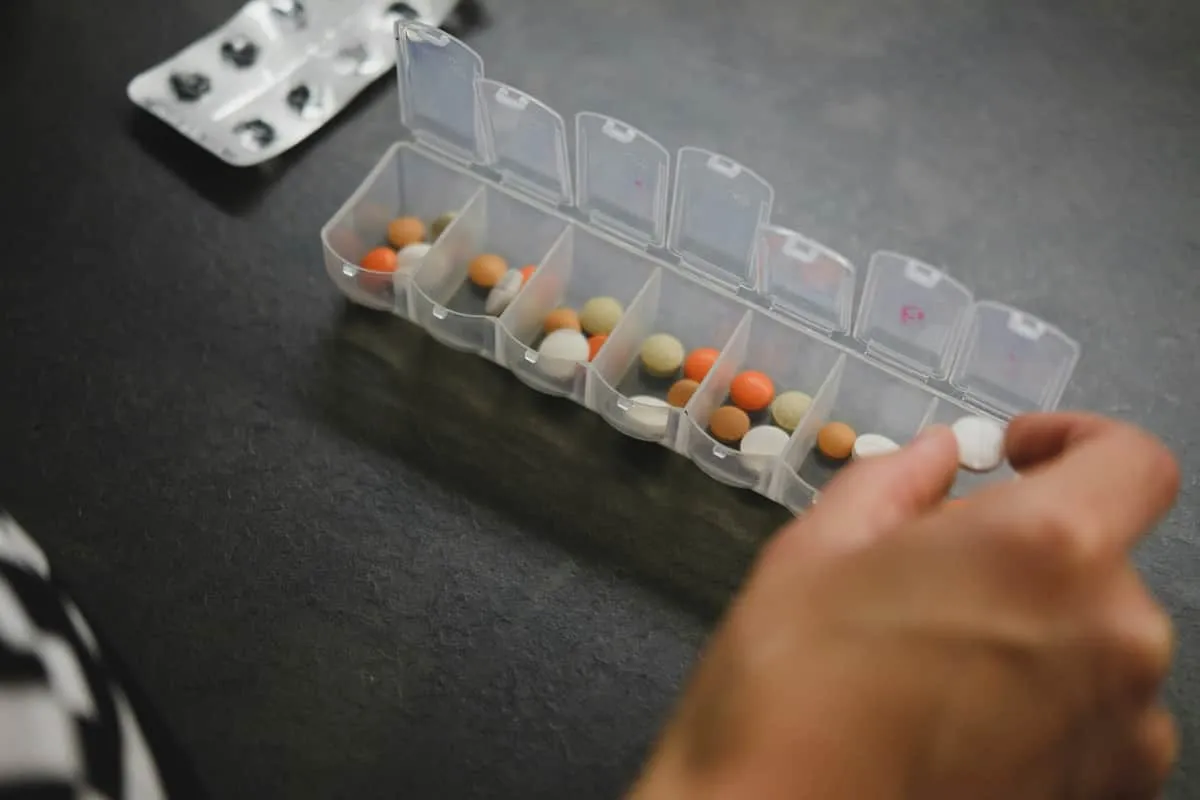
A pill organizer with day/time compartments works well for single-medication routines. For multi-medication senior dogs, a labeled bin with each drug's original container kept together, plus the weekly schedule above on the fridge, is often more reliable than a single pill organizer.
What to Do When You Miss a Dose
The right answer depends on the medication. General principles:
- Gabapentin: Give it as soon as you remember. If it's almost time for the next dose, skip the missed dose and resume the regular schedule. Do not double up, sedation risk increases.
- NSAIDs (carprofen, meloxicam, grapiprant): Generally, give the missed dose if it's within a few hours of the scheduled time. If it's nearly time for the next dose, skip the missed one. Never double up, NSAID GI side effects are dose-dependent.
- Antibiotics: If within a few hours of the scheduled time, give it. If much closer to the next dose, skip and resume. Missed antibiotic doses are more clinically significant than other missed meds, repeated missed doses can extend treatment duration. Contact your vet if you miss more than one dose.
- Thyroid medication (levothyroxine): A single missed dose is rarely critical because thyroid hormone has a long biological half-life, but consistency matters cumulatively. Give the missed dose if same-day; otherwise resume the next day.
- Eye and ear medications: Generally same-day catch-up is fine. Missed doses are usually less critical than systemic medications.
- When in doubt, call the vet. Especially for medications you have just started or for any controlled substance, the right answer depends on the specific drug, your dog's other medications, and how much time has passed.
The most important habit: log every missed dose in Section 4, even if you do nothing about it. The pattern matters more than the single instance.
Sample Filled Entry (Lucy's Schedule)
Continuing the hypothetical Lucy from our health record template, an 11-year-old spayed Labrador on a multi-medication senior regimen:
Master Medication List (Section 1)
| Medication | Strength | Dose | Frequency | Given With | Start | Reason | Vet | Refill |
|---|---|---|---|---|---|---|---|---|
| Carprofen | 75 mg | 1 tablet | Twice daily | Food | 2024-09-15 | Hip arthritis | Dr. Chen | 4 |
| Gabapentin | 100 mg | 1 capsule | Three times daily | Anytime | 2024-11-20 | Chronic pain adjunct | Dr. Chen | 2 |
| Levothyroxine | 0.5 mg | 1 tablet | Twice daily | Empty stomach 1h before food | 2023-06-04 | Hypothyroidism | Dr. Chen | 6 |
| Omega-3 fish oil | 1000 mg | 1 capsule | Once daily | Food | 2024-11-01 | Joint / skin / coat | OTC | , |
| Cosequin DS | , | 1 chew | Once daily | Anytime | 2024-09-15 | Joint supplement | OTC | , |
Weekly Schedule Grid (Section 2): Sample Week
| Time | Mon | Tue | Wed | Thu | Fri | Sat | Sun |
|---|---|---|---|---|---|---|---|
| 6 AM (empty stomach) | L ✓ | L ✓ | L ✓ | L ✓ | L ✓ | L ✓ | L ✓ |
| 7 AM (with breakfast) | C, G, O, Cos ✓ | C, G, O, Cos ✓ | C, G, O, Cos ✓ | C, G, O, Cos ✓ | C, G, O, Cos ✓ | C, G, O, Cos ✓ | C, G, O, Cos ✓ |
| 2 PM | G ✓ | G ✓ | G skipped | G ✓ | G ✓ | G ✓ | G ✓ |
| 6 PM (empty stomach) | L ✓ | L ✓ | L ✓ | L ✓ | L ✓ | L ✓ | L ✓ |
| 7 PM (with dinner) | C, G ✓ | C, G ✓ | C, G ✓ | C, G ✓ | C, G ✓ | C, G ✓ | C, G ✓ |
Legend: L = Levothyroxine · C = Carprofen · G = Gabapentin · O = Omega-3 · Cos = Cosequin
Notes for the week: 2 PM gabapentin Wednesday, Lucy was at a vet appointment and missed the midday dose. Logged in Section 4.
Missed Dose Log (Section 4): Sample Entry
| Date | Medication | Scheduled | Actual | Reason | Vet Said |
|---|---|---|---|---|---|
| 2026-05-13 | Gabapentin 100 mg | 2:00 PM | Skipped | At vet appointment, came home 4:30 PM, almost next dose | Skip rather than double; resume 7 PM |
Refill Tracker (Section 5): Sample
| Medication | Refills | Last Filled | Pills/Day | Run-Out | Pharmacy |
|---|---|---|---|---|---|
| Carprofen 75 mg | 4 | 2026-04-10 | 2 | 2026-06-10 (60 days) | Vet pharmacy |
| Gabapentin 100 mg | 2 | 2026-04-22 | 3 | 2026-06-22 (60 days) | Vet pharmacy |
| Levothyroxine 0.5 mg | 6 | 2026-03-15 | 2 | 2026-08-15 (180 days) | Vet pharmacy |
What this sample says: Lucy is on five daily items, three of which need refills within the next two months. Setting a calendar reminder for refill orders around 2026-06-01 prevents both Carprofen and Gabapentin from running out at the same time.
Digital Alternatives
Several digital tools work for medication tracking. None replace the printable above; many complement it.
- Google Sheets / Notion / Apple Notes, same setup as the printable template, with the advantage of accessibility from your phone
- Medisafe app, a human medication reminder app that works fine for pets too. Free tier handles multiple medications with reminder alerts
- Pawprint app, BabelBark, 11pets, dedicated pet medication tracking with refill reminders, vet appointment scheduling
- CareCredit app, useful for tracking vet costs alongside medication if you use CareCredit
- Pet insurance company apps, Trupanion, Healthy Paws, Embrace, Pets Best apps include medication record sections
The best system is the one you'll actually open. A perfect Notion database in a folder you don't visit is worse than a coffee-stained printable on the fridge that everyone in the household sees.
Frequently Asked Questions
How do I keep track of multiple senior dog medications?
The combination that works for most households: a Master Medication List (Section 1) that lives in a binder or fridge magnet sleeve, a Weekly Schedule Grid (Section 2) printed fresh each week and checked off at each dose, and a Refill Tracker (Section 5) reviewed every Sunday to flag medications running low. For households with one caregiver, the daily checklist (Section 3) is often simpler than the weekly grid.
What should I do if I miss my senior dog's medication dose?
The right answer depends on the medication. General rule: if you're within a few hours of the scheduled time, give the missed dose. If you're closer to the next scheduled dose, skip and resume. Never double up. For gabapentin specifically, skipping is preferred to doubling because of sedation risk. For antibiotics, missing multiple doses is more clinically significant, call your vet. When in doubt, call the vet.
Can I use a pill organizer for senior dog medications?
Yes, with caveats. A 7-day pill organizer works well for single medications or simple two-medication routines. For senior dogs on three or more medications with different schedules (some twice daily, some empty stomach, some with food), a pill organizer often increases confusion rather than reducing it. The safer setup is keeping each medication in its original labeled container and using the weekly schedule grid above to track administration.
How should I store my senior dog's medications?
Most medications need cool, dry storage at 20 to 25°C (68 to 77°F) with humidity below 40%. Avoid the bathroom and kitchen (steam and heat). Use the original container with intact label. Refrigerated medications go in the main fridge compartment (not the door). Lock up controlled substances. Keep pet medications separate from human medications to prevent accidental mix-ups.
How often should I review the medication schedule with my vet?
At every wellness visit (annually for healthy seniors, twice yearly per AAHA recommendations for dogs over age 8), bring the Master Medication List for the vet to review. Additionally, any time a new medication is added or a dose is changed, the new schedule should be confirmed with the prescribing vet before the next dose. The 2023 AAHA Senior Care Guidelines specifically flag medication reconciliation as a senior wellness exam component.
What's the difference between this template and the health record template?
The health record template is the broader senior dog tracking framework, identification, vaccinations, vet visits, weekly QoL scoring, daily observations, emergency contacts. The medication schedule template is deeper detail on medications specifically, the daily administration, the missed-dose log, the refill tracker. A complete tracking system uses both. The medication schedule lives inside the broader health record framework.
Can I share this template with my vet?
Yes. A digital version (Google Sheets, Notion, PDF scanned with phone) lets your vet review the medication schedule during or before the appointment, which often shortens the diagnostic conversation. Most vets prefer informed owners with structured records, particularly when discussing chronic pain or polypharmacy.
Sources
- 2022 AAHA Pain Management Guidelines for Dogs and Cats. aaha.org/resources
- 2023 AAHA Senior Care Guidelines for Dogs and Cats. aaha.org/resources
- FDA, Properly Store Medications to Keep Your Pet Safe. fda.gov
- VCA Animal Hospitals, Safe Handling of Medications at Home. vcahospitals.com
- VCA Animal Hospitals, Gabapentin reference. vcahospitals.com
- Zoetis, Does Missing a Dose of Your Pet's Medication Put Them at Risk? zoetispetcare.com
- University of Illinois College of Veterinary Medicine, Pharmacist's Corner: Proper Storage and Handling. vetmed.illinois.edu
- Whole Dog Journal, Gabapentin for Dogs reference. whole-dog-journal.com
Keep Reading
- Free Senior Dog Health Record Template, the broader senior tracking framework this fits inside
- Help an Old Dog with Arthritis at Home, the multimodal pain management context
- Best Joint Supplements for Senior Dogs, supplements vs prescription medications
- Dog Hospice Care at Home, medication management in late-life care
- Senior Dog Won't Eat, when medication side effects suppress appetite
- Quality of Life Scale for Dogs (HHHHHMM), for tracking whether the medication plan is delivering comfort
- Dog Pacing at Night in Old Age, pain medication trial as a diagnostic tool
About the authors
Sarah Bennett writes about senior dog care from a household centered on her Border Collie Lucy. The 5-medication daily layout was the practical bound, anything more complex needs vet team support, not a paper template. She is not a veterinarian; her work is reported, sourced from veterinary literature, FDA guidance, and AAHA-aligned tools, and reviewed against published guidelines.
Leo Bennett is the co-author of Senior Dog Daily and Sarah's husband. The pair share research and writing duties on the site.