
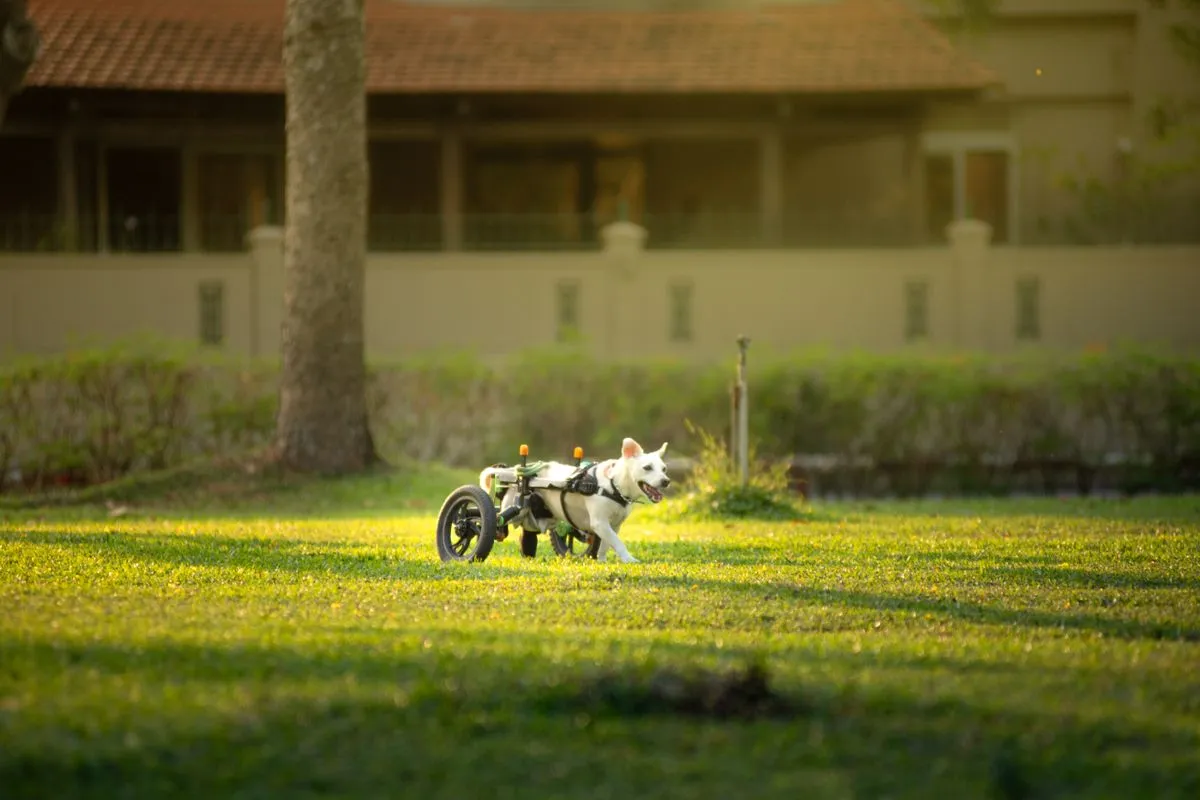
Walkin' Wheels Dog Wheelchair Review (2026)
By Sarah Bennett · Last updated June 18, 2026 · 12 min read
There is a particular grief in watching a dog you love lose the use of her back legs, whether to degenerative myelopathy, a spinal injury, or arthritis that finally wins. The instinct is to think the end is near. Often it is not. A dog wheelchair can give a bright, willing dog months or years of walks, sniffs, and ordinary good days that her legs alone could no longer provide, and the Walkin' Wheels is the dog wheelchair for senior dogs that most owners and rehab vets reach for first. This Walkin' Wheels review is about whether it earns that reputation, and just as importantly, whether your dog actually needs a wheelchair yet or whether something simpler comes first. I write as a researcher and owner, not a veterinarian, and none of this replaces an exam.
Our Ratings at a Glance
Some picks below are affiliate links. If you buy through one, we may earn a small commission at no extra cost to you. It never affects our ratings.
1
Walkin' Wheels Dog Wheelchair4.5 / 5Best adjustable wheelchair for a dog with weak or paralyzed back legs
- Adjustable rear-support cart; 5 sizes from Mini (2-10 lb) to Large (70-180 lb)
- For hind-leg weakness or paralysis from degenerative myelopathy, IVDD, cruciate injury, or severe arthritis
- Rear-support models run about $219-$529; full-support (4-wheel) about $539-$834; check the live price
- Lightweight and adjustable in height, length, and width; SureFit sizing calculator on the brand site
- Needs a real fitting and an adjustment period; works only for a dog with a strong front end
This Walkin' Wheels Review in One Minute
What it is: a fully adjustable dog wheelchair, mostly a rear-support cart that takes the weight of a dog's failing back end so she can walk, potty, and exercise on her own front legs. It comes in five sizes and adjusts in height, length, and width.
Does it work: for the right dog, genuinely yes. Many dogs with weak or paralyzed back legs take to a cart within minutes to days and get a real life back. It works best for a dog whose front end is still strong.
Who it is for: dogs with hind-leg weakness or paralysis from degenerative myelopathy, IVDD, a cruciate injury, or advanced arthritis, who are otherwise bright and want to move.
Who should wait: dogs who only need occasional help and can still bear some weight, where a rear-support sling is cheaper and enough, and dogs weak in all four legs, who need a full-support model, not a standard rear cart.
What it costs: rear-support models run about $219 to $529 depending on size, with full-support four-wheel versions roughly $539 to $834. Check the live price, as it varies by size and over time.
How the Walkin' Wheels Dog Wheelchair Works
The idea is simple and kind: instead of dragging or being carried, a dog with a failing back end is supported by a lightweight frame on two wheels, her hind legs resting in stirrups or lifted in a sling, while she powers herself forward with her front legs. The whole point is independence, letting her walk to her water bowl, out to the yard, and around the block under her own steam.
What makes the Walkin' Wheels the default recommendation, and the best dog wheelchair for most situations, is that it is fully adjustable in height, length, and width, so one cart can be dialled in to a specific dog and re-adjusted as her body or her disease changes. That also means fitting is a real, careful step, not a guess. You measure your dog (the brand's SureFit calculator and measuring guides walk you through it, the key number being rear-leg height with your dog lying on her side and her leg at a natural bend), choose a size, then adjust the frame and clip the harness so she sits level and comfortable.
| Specs | Price | What's included | What it does |
|---|---|---|---|
| Adjustable rear-support cart, 5 sizes (2-180 lb); aluminum frame, lightweight | About $219-$529 rear support; $539-$834 full support; check live price | Frame, wheels, harness, and leg rings or stirrups; sizing support via SureFit | Takes the weight off weak or paralyzed back legs so a dog can walk, potty, and exercise using her front end |
Does a Dog Wheelchair Actually Help a Senior Dog?
Yes, and for the right dog the change can be remarkable. The most common story owners tell is of a dog who had grown depressed and stuck lighting up the first time she realizes she can move again. For a dog wheelchair for degenerative myelopathy in particular, a cart is close to essential equipment: DM slowly takes the back legs while leaving a dog otherwise well and eager, and a wheelchair gives her the mobile, dignified months the disease would otherwise steal. The same goes for paralysis, recovery from spinal surgery, and arthritis severe enough that the back legs simply give out.
Two honest conditions, though. The first is that do dog wheelchairs work depends on the dog having a strong front end, because in a standard rear cart she does the driving with her front legs. A dog weak in all four needs a full-support, four-wheel version instead. The second is the adjustment period: many dogs adapt within minutes, but some take days or weeks, and a few never fully settle, especially anxious dogs or those introduced late. Starting on a flat, familiar surface and keeping early sessions short and rewarding makes the difference.
Sling vs Rear Cart vs Full Support: What Your Dog Actually Needs
This is the part no product page tells you, and it is where most money is wasted. A wheelchair is not always the right first step, and the right type depends entirely on your dog. The honest decision:
| Option | Roughly what it costs | Best for |
|---|---|---|
| Rear-support sling or harness | $20 to $60 | A dog who can still bear some weight and just needs a lift on walks and stairs, or help during early or intermittent weakness |
| Rear-wheel cart (Walkin' Wheels) | About $219 to $529 | A dog who has largely lost rear-leg function but has a strong front end (DM, paralysis, severe hind-end arthritis) |
| Full-support / quad cart | About $539 to $834 | A dog weak or unstable in all four legs, or with front-end involvement as well |
The takeaway: if your dog still has good days and only needs a hand now and then, start with a support sling or harness, which is a fraction of the cost. Move to a rear cart when the back legs are reliably failing but the front end is strong, and to a full-support model only when all four legs need help. Matching the tool to the stage saves both money and frustration.
What Owners Actually Complain About
A fair Walkin' Wheels review has to include the real friction, because a cart is a big purchase:
- The cost. Even the entry models are a couple of hundred dollars, and large or full-support carts run well past $500. It is the single biggest barrier, and it is why renting or buying used is worth considering.
- Fitting takes patience. Getting the height, length, and harness clips right so a dog sits level is fiddly, and some owners need a few tries or a call to the company's fitting line to nail it.
- Occasional quality-control slips. Reviews include the odd serious complaint, such as an off-center adjustment hole or stitching that came loose with daily use. They are not the norm, but inspect a new cart and use the warranty if something is off.
- Width and crashing. A cart is wider than your dog, so doorways and furniture become obstacles, and early walks take real concentration.
- It is not 24/7 gear. Carts are for supervised, active time, not all-day wear, to avoid pressure sores and let her rest and toilet normally.
None of these outweigh what a cart gives the right dog. They are the practicalities that decide whether you buy now, buy used, or start with a sling.
Who Should Buy a Walkin' Wheels, and Who Can Wait
Buy one if:
- Your dog has lost reliable use of her back legs to degenerative myelopathy, paralysis, spinal injury, or severe arthritis, but is otherwise bright and wants to move.
- Her front end is still strong enough to drive a rear cart (or you are looking at a full-support model for all-four weakness).
- You are ready to measure carefully and give her time to adjust.
You can wait if:
- She still bears weight and only needs occasional help, where a sling or harness is cheaper and enough for now.
- Her weakness is new and undiagnosed, and you do not yet know whether it is treatable; see the vet first.
For the dog in that first list, a wheelchair is one of the highest-impact purchases in all of senior care: not a last resort, but a way to give a willing dog her life back.
What a Walkin' Wheels Costs
Pricing tracks size and type. Rear-support Walkin' Wheels cost about $219 for the Mini up to roughly $529 for the Large, while full-support four-wheel models run from about $539 to $834. Those were the figures at the time of writing, and it is worth checking the live price on the official Walkin' Pets site, since it varies by size and changes over time. Because the carts are fully adjustable and resizable, a used or rented one can fit your dog too, which is a sensible way to cut the cost or to trial whether your dog will take to a cart before committing. Set against the alternative, a willing dog with nowhere to go, the value for the right dog is high.
Frequently Asked Questions
Do dog wheelchairs really work?
For the right dog, yes. A dog wheelchair works by supporting the weight of weak or paralyzed back legs so a dog can move under her own power, and many dogs adapt within minutes to days and regain real mobility and spirit. It works best for a dog with a strong front end driving a rear-support cart; a dog weak in all four legs needs a full-support model. A short adjustment period is normal, and starting on flat, familiar ground helps.
How to measure a dog for a wheelchair
To measure a dog for a wheelchair, the key figure is rear-leg height: with your dog lying on her side and her back leg at a natural bend, measure from the top of the leg to the toe pad. You also confirm her weight and length to choose a size. Walkin' Pets provides a SureFit calculator and measuring guides, and a careful measurement is what gets you a cart that sits level and comfortable rather than one that needs constant readjustment.
Is a Walkin' Wheels good for degenerative myelopathy?
Yes. A dog wheelchair for degenerative myelopathy is close to essential equipment, because DM gradually takes the back legs while leaving a dog otherwise well and eager to move. A rear-support cart gives a DM dog mobile, dignified time for months that the disease would otherwise take, and because the Walkin' Wheels is adjustable, it can be re-fitted as the disease progresses toward the front end.
Rear support vs full support dog wheelchair: which do I need?
Match the cart to the dog. A rear-support cart suits a dog who has lost her back legs but still has a strong front end, which covers most degenerative myelopathy, paralysis, and hind-end arthritis cases. A full-support, four-wheel cart is for a dog who is weak or unstable in all four legs or who has front-end involvement. Buying a rear cart for an all-four-weak dog is the most common mismatch, so it is worth confirming with your vet or the company's fitting team.
Is there a cheaper option than a dog wheelchair?
For a dog who still bears some weight and only needs occasional help, a rear-support sling or harness, often $20 to $60, can be enough and is the sensible first step. A full wheelchair earns its cost when the back legs have reliably failed. Renting or buying a used Walkin' Wheels, which is fully adjustable to a new dog, is another way to lower the cost or to trial a cart before buying new.
Sources
- Walkin' Pets: Walkin' Wheels Dog Wheelchairs, official product and pricing pages. https://walkinpets.com/collections/dog-wheelchairs
- Walkin' Pets: How to Measure for a Walkin' Wheels Dog Wheelchair. https://help.walkinpets.com/en-US/how-to-measure-for-a-walkin-wheels-dog-wheelchair-842123
- AAHA 2023 Senior Care Guidelines for Dogs and Cats. https://www.aaha.org/resources/2023-aaha-senior-care-guidelines-for-dogs-and-cats/
Keep Reading
- Degenerative Myelopathy in Dogs, the painless disease a wheelchair most often answers
- How to Lift a Senior Dog with Hip Pain, the technique for the stage before a cart
- Best Harness for Senior Dogs, the support slings that often come first
- Senior German Shepherd Health Problems, a breed where hind-end decline is common
- Making Your Home Easier for a Senior Dog, the floor-and-furniture setup around a less mobile dog
The Bottom Line of This Walkin' Wheels Review
If your dog has lost the use of her back legs but still has the heart and the front-end strength to move, this Walkin' Wheels review lands on a clear recommendation: it is worth it, one of the few purchases that can hand a willing dog her life back, as long as you measure carefully and give her time to adjust. Start with a sling if she only needs occasional help, choose a rear cart when the back legs have reliably gone, and a full-support model when all four need help. A wheelchair is not the end of the road for a senior dog. For the right one, it is a good stretch of road she would not otherwise get.
About the author
Sarah Bennett writes Senior Dog Daily from a home built around her Border Collie, Lucy. I am not a veterinarian; I report and check against published guidance and the manufacturer's own specifications, and my aim is to help you make a clear-eyed decision, not to sell you something your dog does not need.