
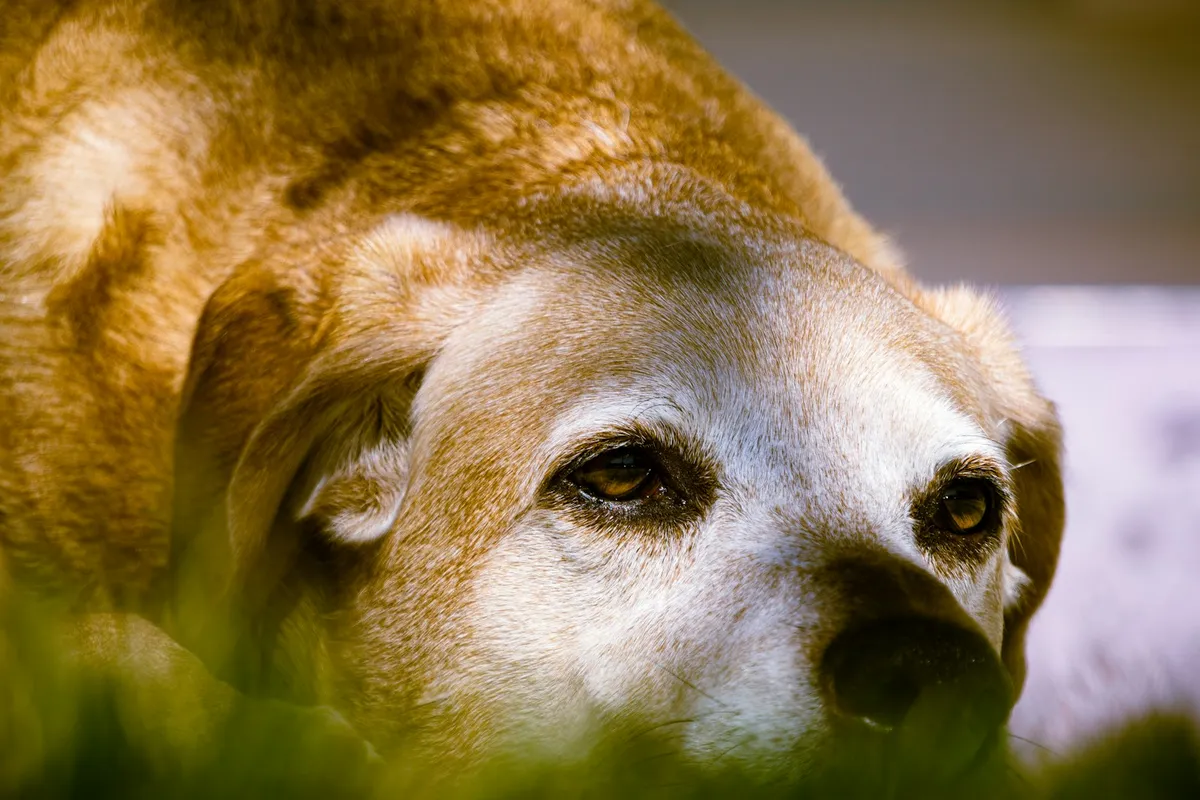
Cloudy Eyes in Senior Dogs: Which Ones Can Wait, and Which Cannot
By Sarah Bennett · Last updated September 13, 2026 · 12 min read
Cloudy eyes in senior dogs are usually the harmless thing. A soft bluish haze that arrived over years, in both eyes, in a dog who still finds her toys, is the most common version and it needs an appointment rather than a car journey. But two questions separate that from the version that cannot wait until Monday, and neither of them requires you to know the name of a single eye condition.
Go now if any of these are true
It hurts. Squinting, holding the eye shut, pawing at it, shying from your hand, or going quiet and withdrawn. It arrived suddenly. Clear on Tuesday, cloudy on Wednesday. The white of the eye is red, or the eye looks bigger than the other one. She is bumping into things she has always managed.
Call the clinic on the way. An eye that is painful and pressurized is measured in hours, not days.
Two Questions That Sort the Whole List
Every article about this will hand you the list: nuclear sclerosis, cataract, glaucoma, uveitis, dry eye, corneal ulcer. The list is accurate. It is also not what you need at nine in the evening, because telling those apart is done with a pressure gauge and a stain, not with a phone light and a search engine.
What you can do is answer two questions, and between them they sort the entire list into tonight and this month.
Does it hurt? A dog with a painful eye tells you, just not loudly. She squints, or keeps the eye half closed. She turns her head away when you reach for it. She paws at her face, or rubs it along the sofa. She goes flat and quiet, which is what dogs do with pain that does not stop. The harmless haze causes none of this.
Did it arrive suddenly? The common aging change takes years and you notice it in a photograph from last summer rather than in the moment. Something that was not there last week is a different category of event.
| The slow bluish haze | Needs a vet today | |
|---|---|---|
| How it arrived | Over months or years | Days, or overnight |
| One eye or both | Both, roughly evenly | Often one, and the difference is obvious |
| Pain | None | Squinting, pawing, head-shy, withdrawn |
| The white of the eye | Normal | Red, bloodshot, or angry |
| Eye size | Normal | One may look larger or bulging |
| The pupil | Reacts normally to light | May look fixed, or wider than the other |
| Getting around | Fine, maybe hesitant in the dark | Bumping into furniture she knows |
| Her mood | Herself | Flat, hiding, off her food |
Most senior dogs land entirely in the left column, and that is worth saying plainly. But nothing in the left column includes pain, redness, or a change you can date to this week. Any one of those three moves the whole picture right, and the right column is a phone call rather than an observation period.
The Common One: A Bluish Haze That Is Not a Cataract
This is what most owners are actually looking at, and it has a name worth knowing because it will stop you worrying: lenticular sclerosis, also called nuclear sclerosis.
Cornell's Riney Canine Health Center describes both the look and the reassurance in one place. The appearance: "As your dog ages, you may notice a bluish haze developing deep in their eyes, behind the pupils". And the likelihood: "More than likely, if your dog is still able to see, this bluish haze is a common, normal, aging change called lenticular sclerosis or nuclear sclerosis".
What is physically happening is unglamorous. Over a lifetime the lens keeps making fibers and cannot shed the old ones, so the center compacts: "the lens fibers become compressed and somewhat degenerative over time, resulting in translucency". A translucent lens scatters light, which is what you see as haze.
The part that matters most to you: "Lenticular sclerosis will not make dogs blind; they just may not see fine details like they once did".
So the picture is a dog who looks cloudy in both eyes, navigates her house normally, still spots the treat you dropped, and is possibly a bit more cautious on the stairs at dusk. That dog needs her next routine appointment, not tonight.
One honest limit: a cataract and sclerosis can look similar enough through a doorway that guessing is not a plan, and the two are told apart in about ten seconds by someone with a light and a magnifier. If you want to know which you are looking at, that is the reason to book, and it is a reasonable one.
The One That Cannot Wait: Glaucoma
Glaucoma is pressure inside the eye rising past what the eye can tolerate. It is the reason the two questions at the top of this page are worth answering before anything else, because it hits both: it hurts, and it can come on fast.
The American College of Veterinary Ophthalmologists is direct about the stakes: "Increased IOP is painful and causes damage to the retina and optic nerve, which can rapidly lead to irreversible blindness".
VCA puts the clinical position in four words, "Acute glaucoma is an emergency.", and explains what the urgency is actually about: "It is important to reduce the IOP as quickly as possible to reduce the risk of irreversible damage and blindness". The clock is not about the diagnosis. It is about how long the optic nerve sits under pressure.
Cornell gives the number a vet will be working against: "Eye pressures above 40-50mm require emergency treatment". You cannot measure that at home, which is the whole point of going.
What it looks like from your side of the room: one eye suddenly cloudy or bluish, the white of that eye red, the eye possibly looking larger, the pupil wide and unresponsive, and a dog who does not want her head touched. She may be quiet and withdrawn rather than obviously distressed, which is how senior dogs usually express pain.
You will notice these overlap with the harmless haze on exactly one feature, the cloudiness. Everything else is different, and everything else is what you should be looking at.
Cataracts, and Why They Sit in the Middle
A cataract is the lens itself becoming opaque rather than compacted, and it does block vision. It is neither a tonight problem nor a shrug.
The middle position is real: cataracts usually progress over weeks to months, so there is time to plan, but they can cause inflammation inside the eye that leads to glaucoma, which is why "we will keep an eye on it" is not the same as leaving it alone. We have written the full version, including the stages, what surgery involves and what it costs, in our guide to senior dog cataracts.
If your dog is diabetic, that page is the one to read rather than this one. Diabetic cataracts behave differently from age-related ones, they arrive faster, and the numbers are on that page with their source.
The Rest of the List, and the Tell for Each
These are the other things a cloudy or wrong-looking eye turns out to be. Each is included with the feature that distinguishes it, not so you can diagnose it, but so the questions you get asked make sense.
Uveitis, inflammation inside the eye. Often painful, often red, and the eye may look duller rather than bluer. It can follow a cataract, and it can raise pressure, which is the route to glaucoma.
A corneal ulcer, damage to the surface. Usually painful out of proportion to how it looks, often with squinting and watering, and often in one eye after a scratch or a bump. It is diagnosed with a fluorescein stain that takes a minute.
Dry eye, when tear production falls. Thick discharge, a dull surface rather than a clear one, and a dog who blinks a lot. It is measured with a paper strip against the lower lid, and it matters because untreated it damages the cornea.
A scar or an old injury that has been there for years and is not going anywhere. Worth confirming once so it stops being a question.
All of these belong to the right column when they come with pain, redness, or sudden onset, and to a normal appointment when they do not. Cornell's own emergency guidance draws the line in one sentence: "If you notice squinting, redness, swelling, pawing at the eye, or sudden cloudiness or discharge, have it evaluated promptly".
What the Vet Will Actually Do
Three quick tests answer most of this, and knowing their names makes the appointment less opaque.
Tonometry measures the pressure inside the eye with a small instrument that touches the surface for a second. This is the test that finds or rules out glaucoma, and it is the reason a painful eye should not wait.
Fluorescein stain puts an orange dye on the surface; under a blue light it sticks to any break in the cornea. This finds ulcers.
A Schirmer tear test places a paper strip inside the lower lid for a minute to measure tear production. This finds dry eye.
None of the three requires sedation and together they take a few minutes. A vet will also look into the eye with a light and a lens, which is how sclerosis and cataract get separated in the ten seconds you cannot do at home.
Frequently Asked Questions
Is a cloudy eye in an old dog just normal aging? Usually yes. The common version is lenticular sclerosis, a bluish haze in both eyes that develops over years and, in Cornell's words, will not make dogs blind. What makes it not normal is pain, redness, one eye clearly worse than the other, or a change that arrived in days. Any of those four is worth a same-day call regardless of how mild the cloudiness looks.
How can I tell a cataract from normal aging at home? You often cannot, and that is not a failing. The two look similar from across a room and are separated in seconds with a light and a magnifying lens. What you can judge is function: a dog who navigates normally and sees the treat you dropped is behaving like sclerosis, and a dog who has started missing things is worth having looked at sooner.
My dog's eye went cloudy suddenly, what does that mean? It means go today. Sudden is the single most useful word in this whole subject, because the harmless aging change does not do sudden. A cloudy eye that appeared this week, particularly with pain or redness, is the presentation that includes glaucoma, and glaucoma is measured against the clock.
Her eye is cloudy and red, is that an emergency? Treat it as one. Redness plus cloudiness is the combination that most often means pressure or inflammation inside the eye rather than a surface problem, and both of those damage vision while you wait. Call the emergency clinic and describe those two features together.
She is diabetic and her eyes have gone cloudy. See your vet promptly rather than waiting for a routine appointment. Diabetic dogs develop cataracts differently from age-related ones and the timeline is shorter; our page on senior dog cataracts covers what that looks like and what the published figures are.
Sources
- Cornell University College of Veterinary Medicine, Richard P. Riney Canine Health Center. Canine Cataracts. Source of the lenticular sclerosis description and of the statement that it does not cause blindness. Checked 2026-09-13. vet.cornell.edu
- American College of Veterinary Ophthalmologists. Glaucoma. Source of the statement on raised intraocular pressure and irreversible blindness. Checked 2026-09-13. acvo.org
- VCA Animal Hospitals. Glaucoma in Dogs. Source of the emergency statement and of the reason speed matters. Checked 2026-09-13. vcahospitals.com
- Cornell University College of Veterinary Medicine, Riney Canine Health Center. Glaucoma. Source of the pressure threshold. Checked 2026-09-13. vet.cornell.edu
- Cornell University College of Veterinary Medicine, Riney Canine Health Center. When to go to the ER. Source of the eye emergency threshold. Checked 2026-09-12. riney.vet.cornell.edu
Keep Reading
- Senior dog emergency signs, for what else cannot wait and what can
- Senior dog cataracts, the full version including stages, surgery and cost
- A nightlight for a blind senior dog, for living with vision that has already gone
Two questions, and they hold for every eye problem on this page. Does it hurt, and did it arrive suddenly. Cloudy eyes in senior dogs are usually the gentle thing that happens to old lenses, and the two questions are how you know when they are not.
About the authors
Sarah Bennett researches senior dog care from a home centered on her Border Collie, Lucy. I am not a veterinarian; every clinical statement on this page is quoted from Cornell's Riney Canine Health Center, the American College of Veterinary Ophthalmologists, or VCA, and linked at the claim.
Leo Bennett handles the reading and fact-checking behind these pieces, including tracing a widely repeated figure about how fast glaucoma blinds a dog, which none of the sources above actually states.