Mental Stimulation for Senior Dogs: Gentle Brain Games to Keep an Older Mind Sharp
By Sarah Bennett · Last updated June 8, 2026 · 10 min read
Lucy is seven, and the thing that still catches me off guard is how much she wants a job. Her body has started to pick its moments, a little slower up from the floor on a cold morning, but her curiosity has not slowed at all. She still noses every bag I bring in, still watches me cross a room like something good might happen.
That gap, between a body that is starting to age and a mind that is still hungry, is the part I have come to care about most. Because the mind is the part you can keep feeding. An older dog who is bored sleeps more, asks for less, and fades a little faster, and a lot of what looks like "just getting old" is really a dog with nothing to think about. None of it is complicated or hard on aging joints. Most mental stimulation for senior dogs is just letting her use the sense she trusts most, her nose, and giving her small problems worth solving. What I do with Lucy now, and would do for any older dog, is aimed at one thing: keeping the curiosity going after the speed is gone.
Why Mental Stimulation for Senior Dogs Matters
A dog's brain ages the way the rest of her does, and in some dogs that shows up as canine cognitive dysfunction, the dementia-like condition behind a lot of nighttime pacing and confusion. We cannot stop aging. But keeping an older dog mentally engaged is one of the gentlest tools we have, and research in aging dogs has found that an active, enriched life, alongside the right diet, is associated with slower cognitive decline. The clearest version is a 2.69-year study of aged Beagles from the University of California, Irvine, which tested an antioxidant diet, behavioral enrichment, and the two together: each helped on its own, and the combination was additive.
The logic is plain enough: a mind that is used stays more able than one that is idle. Mental work also tires a dog in a good way, the satisfied tiredness of a solved problem, which settles the restlessness that can creep into older dogs and helps them sleep. And it asks almost nothing of a sore body. A dog who can no longer manage a long walk can still spend twenty happy minutes working out where you hid the kibble, and come away just as fulfilled.
The thread through everything below is simple: lead with her nose, keep it short, and make it winnable.
Easy Mental Stimulation for Senior Dogs, One Sense at a Time
Let Her Nose Do the Work
Scent is the sense that ages the slowest, and for most dogs it is the richest one they own. Leaning on it is the single best way to engage an older dog, because it tires her mind without taxing her body at all.
The easiest version costs nothing: scatter her kibble across the lawn or a towel and let her hunt for it instead of eating from a bowl. A snuffle mat, a fabric pad with strips you push food down into, does the same thing indoors and turns a thirty-second meal into a calm ten-minute search. You can hide a few treats around one room and release her to find them, starting easy so she wins. For a dog whose body is slowing, watching her nose light up over a found piece of kibble is a reminder that the dog inside is entirely intact.
Give Her a Problem She Can Eat
A food puzzle gives a dog something to figure out with her paws and nose at her own pace, and the good ones are forgiving enough for an older dog who would rather work lying down. Slide a panel, nudge a cup, tip a board, and food appears. Start with the simplest level so the first try ends in a reward, not a sulk.
A lick mat is the gentlest member of this family, and my favorite for an anxious or tired senior. Smear something soft into the grooves, a little wet food or plain yogurt, and the long, rhythmic licking it asks for is genuinely calming, the canine equivalent of a slow, absorbing task. Freeze it on a warm day and it lasts longer. If your dog has missing teeth or a sore mouth, this is the enrichment that asks nothing of them.
Keep Teaching Her
There is an old line that you cannot teach an old dog new tricks, and it is simply wrong. Older dogs learn well, often better than puppies, because they settle and focus. Teaching is some of the best mental work there is, and it doubles as time together.
Keep the sessions short, five minutes, and keep them winnable. A new trick is lovely, but so is a familiar one, freshly rewarded. Teach a nose touch to your hand, a gentle "find it," a paw, a chin rest. If her hearing is going, pair a clear hand signal with each cue so she can follow your hands when she can no longer follow your voice. End every session while she is still enjoying it, on something she got right, so the next one starts with her wanting more.
Make the Walk About Sniffing, Not Distance
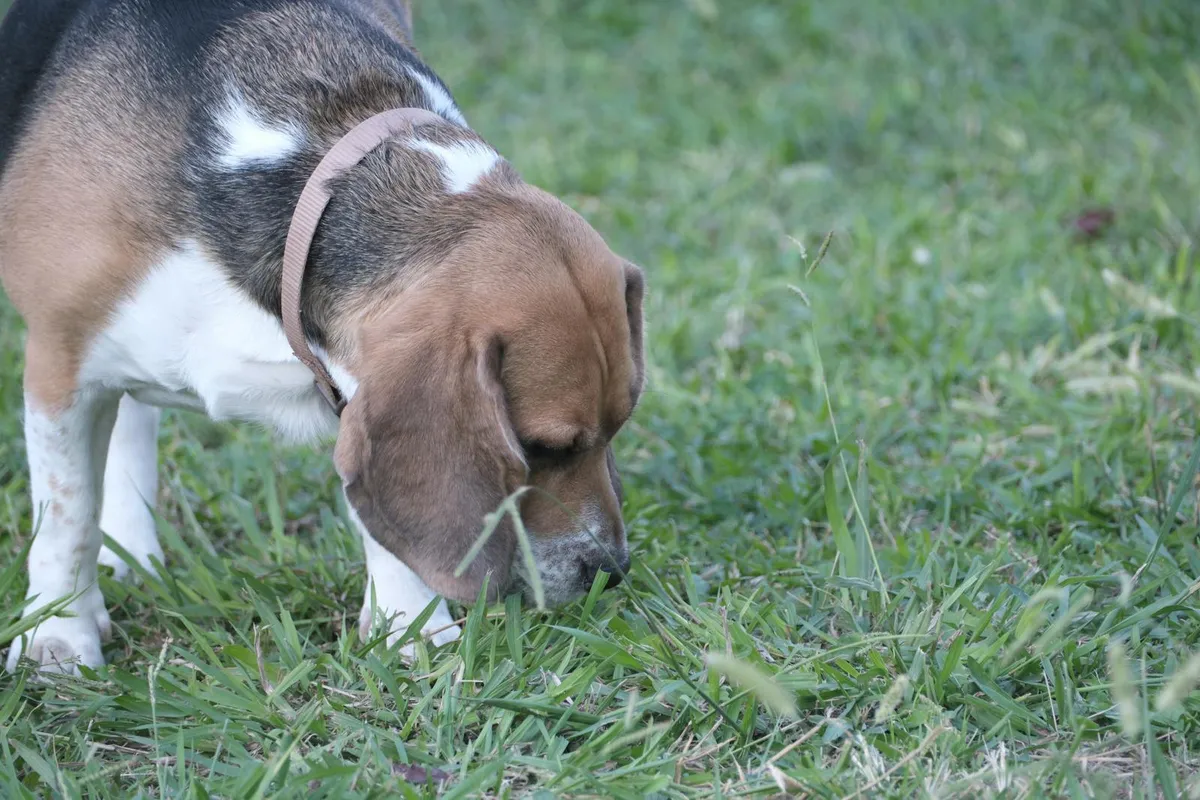
As a dog ages, the walk should slowly change shape. The distance matters less, and what happens along the way matters more. A "sniffari," a short, unhurried walk where she sets the pace and you let her read every post and tuft she wants, is a full mental workout disguised as a stroll, and it is far kinder to stiff joints than a forced march around the block.
Let her stop. Those long pauses at a single patch of grass are not her being slow; they are her reading the news, and that reading is exactly the engagement you are after. A shorter route she gets to investigate beats a longer one you hurry her through, every time. On the days her body is not up for the outdoors at all, a new safe object brought inside, a cardboard box, a paper bag with a treat in it, a different blanket, carries a little of the same novelty to her.
Keep It Kind: Match the Game to Her Body
The one rule that holds all of this together is to meet the dog in front of you, not the one she used to be. Enrichment should leave a senior dog satisfied, never frustrated or sore.
Keep sessions short and stop before she tires. Set every puzzle at a level she can solve, and dial it down the moment it stops being fun, because a frustrated old dog simply quits and learns that the game is not worth it. Work on a non-slip surface so she is not bracing on a slick floor. If her sight is fading, lean even harder on scent and keep the games in familiar spots. If her hearing is going, switch to hand signals and gentle touch. And watch for the difference between a dog who is thinking and a dog who is struggling, since new confusion, getting stuck, or losing interest in food puzzles she used to love can be a sign of cognitive decline worth raising with your vet.
None of this is about keeping a senior dog busy for its own sake. It is about keeping her herself, curious and engaged and part of the day, for as long as you can. The body slows on its own schedule. The mind, with a little help, can stay bright a good while longer.
Frequently Asked Questions
Do senior dogs need mental stimulation? Yes, arguably more than younger dogs. As a dog's body slows, mental engagement becomes one of the main ways to keep her satisfied and involved, and keeping an older mind active is associated with slower cognitive decline. It also settles the restlessness many seniors feel and tires them in a healthy way, without straining aging joints.
What are good brain games for old dogs? The gentlest and most effective lean on scent: scatter feeding, a snuffle mat, or hiding treats around a room. Food puzzles and lick mats give a dog a calm task she can work at lying down, and short, easy training sessions keep her learning. The best games are winnable, brief, and easy on a stiff body.
Can old dogs really learn new tricks? Yes. The saying is a myth. Older dogs often learn very well because they focus and settle more than puppies. Keep sessions to about five minutes, make each one easy to succeed at, and pair cues with hand signals if her hearing is fading, so she can keep learning as her senses change.
Do snuffle mats help senior dogs? They are one of the best low-effort options. A snuffle mat turns a quick meal into a slow, satisfying scent hunt that engages the mind without asking anything of sore joints. It is especially good for dogs who need calming, and it works even for dogs with dental issues, since it relies on sniffing rather than chewing.
How much mental stimulation does a senior dog need? Little and often beats one long session. A few short bursts a day, a snuffle meal, a five-minute training game, a sniff walk at her pace, add up to a well-engaged dog. Always stop before she tires or gets frustrated, and adjust the amount to her energy on any given day.
Sources
- Pop, V., Head, E., Hill, M. A., et al. (2010). Synergistic effects of long-term antioxidant diet and behavioral enrichment on beta-amyloid load and non-amyloidogenic processing in aged canines. Journal of Neuroscience, 30(29). (Institute for Brain Aging and Dementia, University of California, Irvine. A 2.69-year intervention; enrichment and diet each helped, and the combination was additive.)
- Cornell University College of Veterinary Medicine, Riney Canine Health Center. Senior dog dementia.
- American Animal Hospital Association: Senior Care Guidelines for Dogs and Cats, on quality of life and mental engagement in aging dogs. (aaha.org refuses automated requests, so this one is listed by title rather than linked.)
Keep Reading
- Dog Dementia Symptoms: Early Signs of Cognitive Dysfunction
- The 4 Stages of Dog Dementia
- Sundowning in Dogs: Why Old Dogs Get Restless at Night
- Making Your Home Easier for a Senior Dog
About the authors
Senior Dog Daily is written by Sarah Bennett and Leo Bennett, a husband-and-wife team in the American Midwest, with their Border Collie Lucy as the reason it started. Neither of us is a veterinarian. We read the primary sources, including the AAHA senior care guidelines and the veterinary research on cognitive aging, and turn them into plain, practical guides, with the claims traceable to the sources above. With mental stimulation for senior dogs, the goal is not to wear her out but to keep her curious, so lead with her nose, keep it short and winnable, and let an aging dog stay herself for as long as she can.