Senior Dachshund Back Problems
By Sarah Bennett · Last updated May 23, 2026 · 13 min read
If you have lived with a dachshund, you have probably already had the conversation in your head, the one where you imagine her one day refusing to jump off the couch, or yelping when picked up, or worse. The conversation isn't paranoid. Dachshunds carry roughly a 20 to 25% lifetime risk of clinical intervertebral disc disease (IVDD), and as a breed they are 10 to 12 times more likely to develop spinal disc problems than other dogs. The good news is that the picture changes significantly depending on what you do before, during, and after a back episode, and most senior dachshunds with informed owners live full, comfortable lives well into their teens.
Senior dachshund back problems are not one condition; they are a family of related concerns that center on the dachshund's unique chondrodystrophic anatomy. This guide walks through why dachshunds get back problems, what IVDD actually is, the five-grade clinical system veterinarians use, how to recognize an episode early, what to do in the first 24 hours, the crate-rest vs. surgery decision, the daily habits that meaningfully reduce risk, and the other senior dachshund health concerns worth knowing about. We're not veterinarians, and this guide is built from peer-reviewed veterinary neurology literature, the 2022 AAHA Pain Management Guidelines, and Dachshund IVDD Support resources.
If you are looking at the broader differential of "my old dog can't get up the stairs," our companion guide on why a dog can't get up the stairs anymore walks through the six most common causes. This article is for the breed-specific picture.
Why Dachshunds Get Back Problems
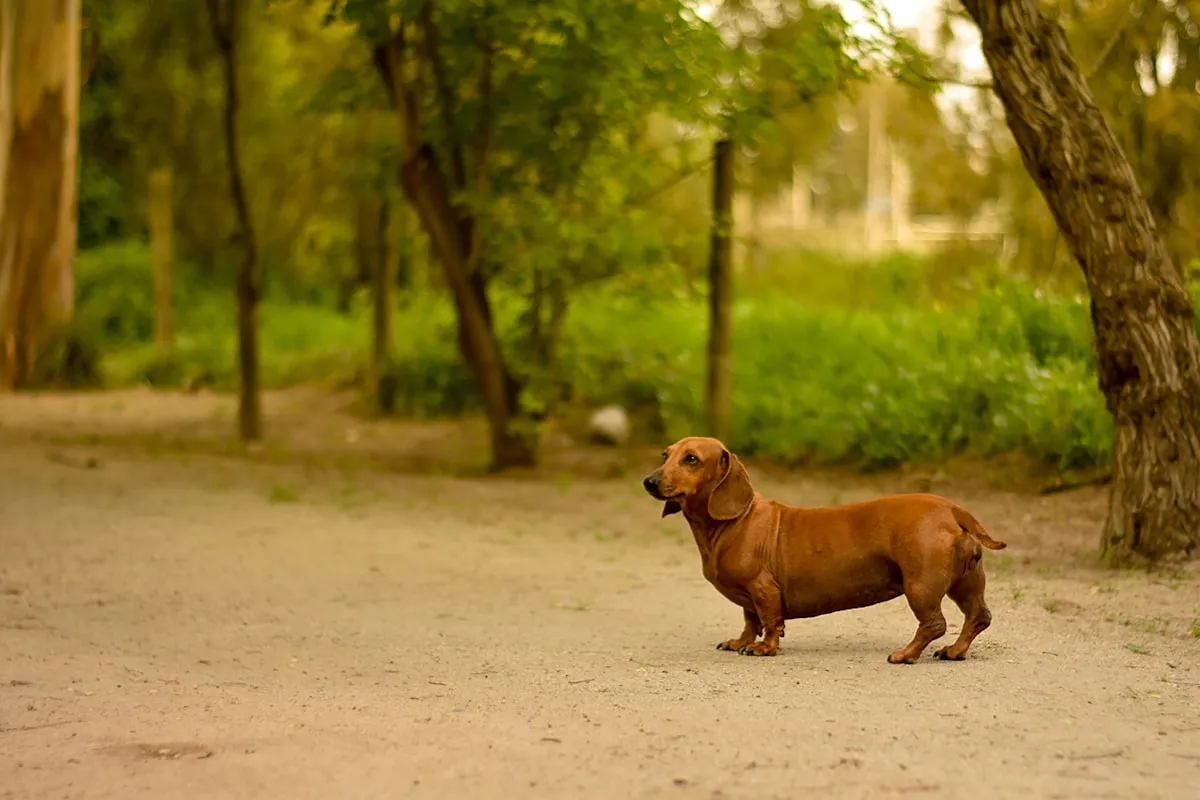
The dachshund silhouette, long back, short legs, is the result of chondrodystrophy, a genetic condition affecting cartilage development. Chondrodystrophic dogs (which also include Pembroke Welsh Corgis, Beagles, Bassets, Shih Tzus, and French Bulldogs) experience early disc degeneration: a loss of proteoglycan and water content in the intervertebral discs, replaced by increased collagen. The discs become brittle and prone to herniating.
In dachshunds, this degeneration starts shockingly early, disc calcification has been observed as early as 4 months of age, and most dachshunds have at least some chondrodystrophic disc change by middle age. The combination of a long spine carrying disc loads, short legs producing leverage, and discs that have been degenerating for years is the anatomical reality of every senior dachshund, whether or not she has had a clinical episode yet.
The discs that fail are typically in the thoracolumbar region (lower back, where the ribcage ends), which is why dachshund back episodes often present as sudden rear-end weakness rather than neck pain.
This is the breed reality, not a verdict. Many dachshunds live their entire lives without a serious episode. The point is that prevention and early recognition matter more for this breed than for almost any other.
IVDD in Senior Dachshunds: The 5-Grade Clinical System
When veterinarians evaluate a dachshund with a possible disc episode, they use a standardized 5-grade neurological scale. Knowing where she falls is the single most important piece of information for deciding what to do next.
| Grade | What you see | Urgency |
|---|---|---|
| Grade 1 | Back pain only, yelping, tensing, reluctance to move; able to walk normally | Vet visit within 24 hours |
| Grade 2 | Ambulatory paresis, she walks but wobbles, hindlimbs are weak or uncoordinated | Vet visit same day |
| Grade 3 | Non-ambulatory paresis, she cannot walk, but voluntarily moves her hindlimbs | Same-day emergency |
| Grade 4 | Paralysis with deep pain perception preserved, no voluntary movement, but she can still feel deep pinch | Surgical emergency; deep pain perception status changes prognosis significantly |
| Grade 5 | Paralysis with no deep pain perception, the most severe presentation | Surgical emergency; the 24 to 48 hour window matters greatly for recovery prognosis |
The fastest way to assess at home: can she walk? Can she move her rear legs at all? If she can walk but is in pain, you have time to call the regular vet. If she cannot walk, you do not. The threshold between Grade 3 and Grade 4, voluntary movement of the rear legs, is the line that most often determines whether conservative treatment is realistic or whether surgery becomes the working answer.
How to Recognize an Episode Early
Most dachshund IVDD episodes do not begin with sudden paralysis. They begin with subtle pain signals that get missed for hours or days. The patterns to watch for:
- Reluctance to jump up or down from furniture she used to vault onto
- Yelping when picked up, especially when the lift involves any back flexion
- A "hunched" or arched back posture when standing, with the spine visibly tense
- Tucked tail combined with reluctance to move the head up or down
- Trembling, panting at rest, or restlessness without an obvious cause, pain signs that are often misread as anxiety
- A subtle dragging or scuffing of a hind paw, a neurological signal that warrants same-day attention
- Decreased appetite paired with general "off-ness", back pain often shows up as reduced food interest
The early signs above, combined with her breed risk, are reason enough for a vet call. The 2022 AAHA Pain Management Guidelines explicitly endorse rapid evaluation for any chondrodystrophic dog showing acute pain signs, because the cost of waiting on a dachshund disc episode is measured in spinal cord damage, not just discomfort.
What to Do in the First 24 Hours
If you suspect a disc episode, the first 24 hours often shape the next six weeks. The right sequence:
1. Stop all activity immediately. No stairs, no couch, no jumping, no walks. If she can walk, walk her only for bathroom breaks on a short leash, no further than necessary.
2. Confine her to a small space. A crate, a small bathroom, or an exercise pen. The goal is to prevent the kinds of movements that put torsion or flexion on her spine. This is not punishment; this is medical management.
3. Call your vet that day, not tomorrow. Even for Grade 1 (pain only) cases, prompt veterinary evaluation and prescribed pain management are the foundation of conservative treatment outcomes.
4. Do not give human pain medication. Ibuprofen and acetaminophen are dangerous for dogs and can complicate the workup. The vet will prescribe NSAIDs, gabapentin, and often methocarbamol, the standard combination for dachshund disc episodes.
5. Lift her with care. Support her under the chest and just in front of her hind legs, never under the abdomen, never with a flexed back. Our how to lift a senior dog with hip pain guide covers the technique that minimizes spinal strain.
What to avoid in the first 24 hours: rolling her onto her back, lifting her by the front legs alone, allowing her to use stairs even once, or "wait and see" past one day. A dachshund with new back pain has the clock against her.
Conservative Treatment: Crate Rest 4-8 Weeks
For Grade 1 and many Grade 2 cases, conservative treatment is the standard of care, and the published data show good recovery rates when the protocol is followed completely. About 92% of owners complete the prescribed rest period, and the recovery success rate is meaningfully tied to that compliance.
The protocol most veterinary neurologists prescribe:
- Strict crate rest, 4 to 8 weeks (8 weeks is the most commonly prescribed length). She is in the crate 24/7, with exits only for short leashed bathroom breaks and prescribed physical therapy
- Multimodal pain management: an NSAID (carprofen, meloxicam, deracoxib), gabapentin for neuropathic pain, and methocarbamol as a muscle relaxant. Doses are adjusted by the vet over the rest period
- No jumping, no stairs, no playing, not even gentle play. Friends and family members who don't understand this rule are the most common reason for relapse
- Sling-supported toileting for cases where she cannot stand to urinate. A folded towel or proper rear-end sling under her belly takes weight off her spine
- Gradual return to activity over weeks 5 to 8, supervised by the vet, short flat-ground walks, no stairs, no off-leash time until the protocol completes
The most common cause of conservative-treatment failure is early return to activity. A dachshund who appears recovered in week 3 is not recovered; the disc tissue is still consolidating. Ending crate rest early is the single biggest preventable relapse driver. The protocol exists because the data say so, not because vets enjoy prescribing eight weeks of crate.
When Surgery Is the Right Answer
Surgery, typically a hemilaminectomy to relieve pressure on the spinal cord, is the standard treatment for higher-grade cases. The general thresholds:
- Grade 3 cases that don't improve within 48 hours of conservative treatment
- Grade 4 cases with deep pain perception preserved, surgical decompression usually outperforms conservative management for these dogs
- Grade 5 cases, paralysis with no deep pain perception, where the 24 to 48 hour window matters greatly for recovery prognosis. Surgery within this window has dramatically better outcomes than delayed surgery
- Recurrent episodes in a dog who has had successful conservative treatment before, especially when the recurrences are at different disc levels
Surgery is expensive, costs typically run $3,000, $10,000+ depending on geography and complication management, and requires a board-certified veterinary surgeon or neurologist. Insurance and CareCredit help significantly with the financial side; pre-existing-condition exclusions are why many dachshund owners purchase insurance early in the dog's life, before any episode.
Post-surgical recovery is its own protocol, typically involving 4 to 6 weeks of restricted activity, structured physical therapy, and often hydrotherapy. Recovery outcomes are best when the surgical decision is made within the recommended window, not held off until forced.
Daily Habits That Prevent Senior Dachshund Back Problems
This is the section that matters most for senior dachshund owners who haven't had a clinical episode yet. The data on prevention are clearer than the data on most veterinary interventions:
1. Weight is the single biggest controllable risk factor. Excess weight amplifies disc loading at every step. A dachshund just 10 to 20% over ideal weight has a significantly higher IVDD risk than a dachshund at ideal weight. The target is a Body Condition Score (BCS) of 4 to 5 on the 9-point scale, visible waist from above, ribs felt under a thin fat covering. For many companion dachshunds, this means feeding less than the bag recommends.
2. No jumping. This is the rule most owners find hardest to follow, and it matters more for dachshunds than almost any other breed. Off the couch, off the bed, in and out of the car, every jump is a torsion event on a chondrodystrophic spine. Replace jumping with ramps everywhere she previously jumped.
3. No stairs (or strictly limited stairs). Stairs combine forward propulsion with spinal flexion, exactly the loading pattern dachshund discs handle worst. Gate the stairs. If she has historically slept upstairs, move her bedding downstairs. If you live in a multi-level home, the relocation is the single highest-leverage household change you can make.
4. Build core strength gradually. A dachshund with strong abdominal and back muscles bears less disc load during everyday movement. Short, flat-ground walks (multiple per day, not one long one), structured physical therapy if accessible, and hydrotherapy where available all help. The opposite, long sedentary periods punctuated by sudden activity, is the worst pattern.
5. Use a harness, not a neck collar, for walks. A neck collar applies leverage through the cervical spine; a chest harness distributes load across her ribcage. For a chondrodystrophic dog, this distinction matters.
6. Lift her correctly. Always support both ends. Never scoop her up by the middle. Never carry her with a flexed spine. The lifting technique guide covers the body mechanics in detail.
The Right Gear for a Dachshund-Proof Household
A handful of household changes do disproportionate work for dachshund spinal health:
- Ramps at every height she previously jumped. Bed, couch, car, low porch step. Our best dog ramp for senior dog guide covers options for each use case.
- Stair gates at the top and bottom. Even one stair-using episode during a flare can produce a setback.
- An orthopedic bed with low-profile entry. A high-walled bed she has to step over is a daily torsion event. A flat or low-entry orthopedic memory-foam bed eliminates the lift-over completely.
- Non-slip flooring in high-use rooms. Slipping on hardwood is one of the more common acute IVDD triggers in dachshunds.
- A properly-fitted chest harness. Front-clip harnesses with wide chest straps distribute leash pressure across the chest; avoid neck-only collars for walks.
- A rear-end sling or full-body harness. For senior dachshunds with any history of back episodes, having a Help 'Em Up Harness or GingerLead on hand for bad days prevents the lifting-related relapses that pure manual technique cannot. See our rear-support and lift harness picks for the fit details that matter on a long back.
Beyond IVDD: Other Senior Dachshund Health Concerns
While back problems get the spotlight, senior dachshunds also have above-average rates of several other conditions. Knowing about them lets you catch them early:
Dental disease. Small-breed dachshunds frequently have crowded teeth that accumulate plaque rapidly. The AVMA reports that more than 80% of dogs over age three have some degree of periodontal disease, and small breeds skew above that average. Daily brushing and annual professional cleaning are the standard.
Cataracts and glaucoma. Both are common eye conditions in older dachshunds. Watch for cloudiness in the lens, bumping into furniture, hesitancy in low-light conditions. Our 8 senior dog aging signs guide covers eye changes in more depth.
Cushing's disease (hyperadrenocorticism). Dachshunds have an above-average predisposition. Watch for increased thirst, increased urination, panting at rest, a "pot-belly" appearance, hair loss, and a thinning coat. Bloodwork plus an ACTH stim test confirms diagnosis.
Degenerative mitral valve disease. A common heart condition in older small-breed dogs including dachshunds. Watch for coughing (especially at night), reduced exercise tolerance, and elevated resting respiratory rate. Annual chest auscultation and (when indicated) echocardiogram are part of senior dachshund care.
Obesity-driven joint disease. Even apart from IVDD risk, excess weight in a dachshund accelerates knee, elbow, and hip changes. The 4 to 5 BCS target serves multiple goals at once.
For appetite and food refusal issues, which often accompany pain or systemic illness in senior dachshunds, our senior dog won't eat guide walks through the seven-cause differential.
Recommended Food, Supplements, and Beds for Senior Dachshunds
A practical bundle, drawing from recommendations covered in more depth elsewhere on this site:
Food: A high-protein, joint-supportive senior diet. Hill's Science Diet Adult 7+ and Royal Canin Mature Adult are the two most-recommended kibble options for senior small breeds; for dogs whose appetite has dropped or who would benefit from softer texture, The Farmer's Dog fresh food is the most-cited subscription option. The best food for senior dogs guide and the Farmer's Dog senior review cover both paths.
Joint and back-supportive supplements: Omega-3 fish oil (EPA/DHA), glucosamine-chondroitin, and undenatured type-II collagen are the three with the most peer-reviewed support. Our best joint supplements for senior dogs guide covers brand-specific recommendations.
Bed: A low-entry orthopedic memory-foam bed sized for a senior dachshund, high-density memory foam (not polyfill or fiber), washable cover, and a profile she can walk onto rather than step into. Covered in best orthopedic dog beds for senior dogs.
Mobility aids: Ramps everywhere she previously jumped; a rear-end sling for bad days; a properly-fitted chest harness for walks. Covered in best dog ramp for senior dogs.
Frequently Asked Questions
What is the lifetime IVDD risk for a dachshund?
Roughly 20 to 25% of dachshunds develop clinical IVDD during their lifetime, with the breed carrying a 10 to 12 times higher risk than the general dog population. The most common age at first episode is 4 to 7 years, though senior dachshunds remain at elevated risk throughout life.
Can a dachshund with back problems live a full life?
In most cases, yes. With informed daily management, weight control, no jumping, ramps, harnesses, and prompt response to early pain signals, most dachshunds who have had a clinical IVDD episode go on to live full, comfortable lives well into their teens. The dachshunds who do worst are those whose owners didn't catch the episode early or didn't complete the prescribed rest protocol.
Should I avoid stairs with my senior dachshund?
For a senior dachshund with any back history, yes. For a senior dachshund with no history, restrict stairs significantly and consider gating them. Stairs combine forward propulsion with spinal flexion, which is exactly the loading pattern dachshund discs handle worst. The relocation of sleeping space to a single floor is the single highest-leverage household change for a multi-level home.
How long does crate rest last for dachshund IVDD?
The most commonly prescribed protocol is 4 to 8 weeks, with 8 weeks being the most-cited length for moderate cases. The crate is 24/7 except for short leashed bathroom breaks and prescribed physical therapy. Ending crate rest early is the most common reason for relapse, so the full protocol matters more than the appearance of recovery in week 3.
When does a dachshund with a back episode need surgery?
Surgery is the standard answer for Grade 3 cases that don't improve within 48 hours of conservative treatment, Grade 4 cases with deep pain perception preserved, and Grade 5 cases (paralysis without deep pain perception, within the first 24 to 48 hours). Grade 1 and many Grade 2 cases respond well to conservative treatment without surgery.
What's the best food for a senior dachshund with back problems?
Any high-quality senior food formulated for AAHA-aligned protein levels (28 to 30% on a dry matter basis) is appropriate. The choice between Hill's Science Diet Adult 7+, Royal Canin Mature Adult, Purina Pro Plan Bright Mind 7+, and a fresh food like The Farmer's Dog depends more on her appetite, dental comfort, and your budget than on her dachshund-ness specifically. Weight management is far more important than the brand within the senior food category.
Can supplements prevent dachshund back problems?
No supplement prevents IVDD. The evidence-supported supplements (omega-3, glucosamine-chondroitin, undenatured type-II collagen) support joint and connective tissue health broadly and may have some protective effect, but the prevention work that matters most is weight control, no jumping, no stairs, and proper lifting, not supplementation.
Sources
- 2022 AAHA Pain Management Guidelines for Dogs and Cats. aaha.org/resources
- AKC Canine Health Foundation, Intervertebral Disc Disease (IVDD) Overview. akcchf.org
- Brisson, B. A. (2010). Intervertebral Disc Disease in Dogs. Veterinary Clinics of North America: Small Animal Practice, 40(5).
- Dachshund IVDD Support Australia, Conservative 101. ivdd.org.au
- Hansen, H. J., Canine chondrodystrophic intervertebral disc disease (Hansen Type I disc disease). PMC Review. PMC4674860
- DachsLife 2015, Lifestyle Associations with IVDD Risk in Dachshunds. PMC5097381
- UC Davis Veterinary Genetics Laboratory, Chondrodystrophy (CDDY and IVDD) testing. vgl.ucdavis.edu
- American Veterinary Medical Association, Periodontal disease in pets. avma.org
Keep Reading
- Help an Old Dog with Arthritis at Home, the broader senior mobility framework
- Dog Can't Get Up the Stairs Anymore, the differential side of mobility loss (IVDD is one of six causes)
- How to Lift a Senior Dog with Hip Pain, proper lifting technique to protect her spine
- Best Dog Ramp for Senior Dogs, the household-side fix for jump prevention
- Best Joint Supplements for Senior Dogs, evidence-supported nutraceuticals
- Best Orthopedic Dog Beds for Senior Dogs, low-entry bed options for dachshunds
- Best Food for Senior Dogs, protein and weight-management considerations
- Senior Dog Won't Eat, when pain or systemic illness affects appetite
- Senior Dog Aging Signs, early indicators beyond back problems
About the authors
Sarah Bennett writes about senior dog care from a household centered on her Border Collie Lucy. The IVDD framework and the conservative-vs-surgical decision pivot were the two anchors Sarah used to organize this guide. She is not a veterinarian; her work is reported, sourced from veterinary literature and peer-reviewed research, and reviewed against published guidelines.
Leo Bennett is the co-author of Senior Dog Daily and Sarah's husband. The pair share research and writing duties on the site.