
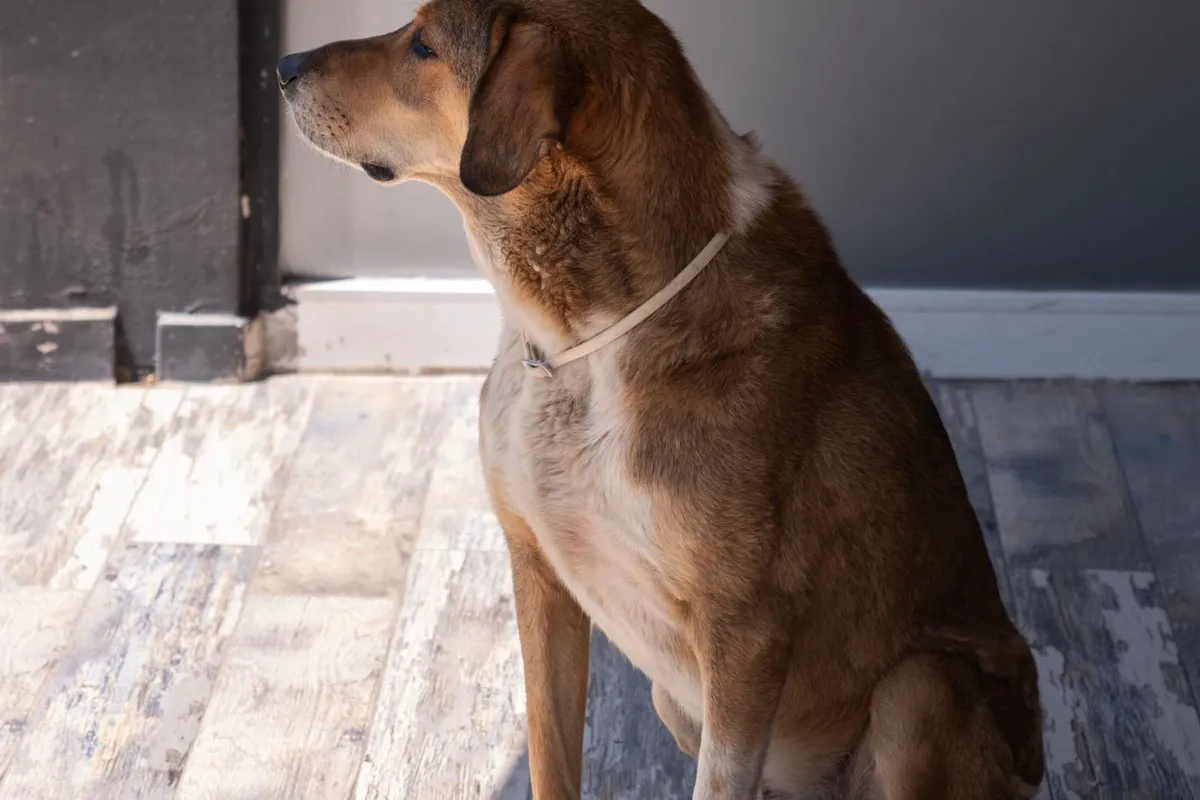
Senior Dog Hearing Loss: She May Not Be Ignoring You
By Sarah Bennett · Last updated September 1, 2026 · 11 min read
I write as a researcher, not a veterinarian. Hearing loss in an older dog is worth mentioning at her next appointment, and sudden hearing loss is worth a call the same week.
The short version: The first sign of senior dog hearing loss is usually a dog who has become selectively obedient. She comes when she feels like it, sleeps through the door, and startles when you touch her. Age-related hearing loss takes the high frequencies first, which is why owners often miss it for months: she still reacts to the door slamming and the food bin, so it does not look like deafness. Gradual loss is expected and untreatable, and it is not an emergency. Sudden loss is a different problem and worth a call. The part almost nobody mentions is that in older dogs, hearing loss and cognitive decline travel together, so the confused dog in front of you may be deaf, may be developing dementia, or may be both, and those need different answers.
Lucy still hears the treat drawer from two rooms away, which tells me nothing except that her low frequencies are fine. That is the trap in this whole subject: the sounds a dog keeps hearing longest are the ones we most often use to test her.
Is She Deaf, or Ignoring You?
Owners almost never arrive at "my dog is going deaf." They arrive at "she has stopped listening," and the two look identical from across a room.
What separates them is consistency. A dog choosing not to come has a pattern to her choosing: she ignores the recall in the yard and hears it in the kitchen, she ignores you and responds to your partner, she ignores the word "come" and reacts to "dinner." A dog losing her hearing is not selective in that way. She misses you consistently from certain positions, particularly behind her, and she responds fine when she can see your face.
Three household observations tell you more than any single test:
- She no longer wakes when you come home, and used to meet you at the door.
- She startles when touched, which is new. A dog who hears you approach is never surprised by your hand.
- She has become louder, barking at a volume she did not use before, or vocalizing in a way that seems disconnected from anything happening.
None of that is proof. All of it is worth telling your vet.
How Hearing Actually Goes in an Older Dog
The clinical name is presbycusis, and the Merck Veterinary Manual's chapter on deafness treats it as an ordinary part of aging rather than a disease: "Many geriatric animals develop presbycusis (age-related hearing loss)."
Two details from that chapter explain most of what owners find confusing.
It arrives late, and it keeps going. Merck puts the timing plainly: "Onset of presbycusis is typically in the last third of a breed's typical lifespan and progresses to complete deafness if the animal lives long enough." For a Labrador that is somewhere past nine; for a Chihuahua it is later. The progression is the part owners are rarely told, and it matters for planning: this is not a level that stabilizes.
The high notes go first, which is why you miss it. Merck again: "Middle to high frequencies are affected first, followed by progressive loss of hearing at all frequencies." The same chapter notes that because the frequencies affected first sit "well above the range of human auditory perception," the loss goes unrecognized for a long time.
That is the whole reason the "she can still hear the food bag" test is worthless. Rustling plastic, a slammed door, and a car engine are low and broad. Your voice calling her name from behind is neither.
Gradual Is Expected. Sudden Is Not.
This is the distinction that decides whether you wait for the next checkup or pick up the phone.
Gradual loss over months, in a dog past middle age, with normal-looking ears, is presbycusis until shown otherwise. There is nothing to treat, and no urgency. Mention it at her next visit so it goes in the record.
Hearing that drops away over days, or after a specific event, is a different question. Merck lists the acquired causes alongside aging: "intrauterine infection or toxins, otitis interna or meningitis, mechanical or noise trauma, ototoxic effects, anesthesia, neoplasms, or aging (presbycusis)." Several of those are treatable, and some are time-sensitive.
Call your vet within the week if:
- Hearing changed suddenly rather than over months
- It followed a new medication, particularly an ear medication or an antibiotic
- It followed anesthesia or a general anesthetic procedure
- There is head tilt, circling, or loss of balance alongside it, which points at the inner ear rather than at age
- Her ears look or smell wrong, which raises the possibility of an obstruction or infection instead
That last one is the only branch with a real chance of reversal. Merck is direct about the rest: "Successful treatment of ear canal obstruction may improve associated hearing loss; however, treatment is generally not available for other forms of deafness." Our guide to recurrent ear infections in senior dogs covers the obstruction side, because chronic inflammation can narrow a canal over years.
On the question every owner eventually asks, the same chapter says: "Clinical experience indicates that hearing aids have limited effect."
The Part Nobody Mentions: Hearing Loss and Dementia Travel Together
This is where a hearing problem stops being a small inconvenience.
A 2022 study from North Carolina State University tested 39 elderly companion dogs, sorting them by measured hearing rather than by owner impression. As the university's write-up describes the grouping, "Of the study cohort, 19 of the dogs could hear at 50 dBs, 12 at 70 dBs, and eight at 90 dBs (roughly equivalent to the noise made by a jet plane at takeoff)." Average ages across those three groups were 12, 13 and 14.
The cognitive results, in the same write-up, lined up with hearing almost exactly: "cognitive questionnaire scores ranked all eight of the dogs in the 90 dB group as abnormal, compared to nine of the 12 in the 70 dB group and eight of the 19 in the 50 dB group." Every dog in the worst-hearing group scored as cognitively abnormal. Fewer than half in the best-hearing group did.
Quality of life moved with it. The NC State write-up reports that "scores related to vitality and companionship declined significantly as hearing deteriorated." Not health scores. Vitality and companionship: how engaged she seems, and how much she still feels like company.
Two cautions about how to read this.
It is an association in 39 dogs, not a demonstration that deafness causes dementia. The study was published in the Journal of Veterinary Internal Medicine (Fefer, Khan, Panek, Case, Gruen and Olby, 2022) and its own framing is that presbycusis is associated with worse executive performance and higher owner-assessed dementia severity. Which direction the arrow runs, or whether a shared aging process drives both, is not settled by a cohort this size.
The human numbers in the coverage are about humans. The lead researcher's remarks note that in people, hearing loss is estimated to affect a third of those over 65 and that cognitive decline runs faster in people with age-related hearing loss. That is the reason the dog study was worth running. It is not a finding about dogs, and it should not be repeated as one.
What it does change is the question you ask. If your older dog seems confused, "is she deaf?" and "is she becoming demented?" are not competing explanations to choose between. Our guides to the symptoms of dog dementia and telling dementia from normal aging are worth reading alongside this one rather than instead of it, and if the confusion is worst in the evenings, sundowning is its own pattern.
Checking at Home, and When a Real Test Is Worth It
Home checks cannot diagnose anything. They can tell you whether to raise it.
Test from behind, out of sight, on a soft surface. Wait until she is awake but not looking at you, stand where she cannot see or feel you, and make a sound she has no other way to detect. Clapping is a poor choice because she feels the air and the floor. A high whistle or jingled keys is better, because the high frequencies are the ones that go first.
Vary who does it and where. A dog who responds to your partner and not to you may have lost the frequency range your voice sits in.
Watch her ears, not her body. Ear twitch toward a sound is a better signal than a head turn, which she may make for movement she caught in her peripheral vision.
The definitive test exists. Merck: "Specialized testing (such as brainstem auditory evoked response, or BAER) provides the most definitive diagnosis." BAER measures the electrical response of the hearing pathway and does not rely on the dog cooperating.
For most senior dogs it is not necessary, because the answer would not change what you do: there is no treatment for presbycusis, and you will adapt the same way either way. It becomes worth the referral in two situations. When the loss was sudden or one-sided, because that raises causes worth finding. And when you genuinely cannot tell hearing loss from cognitive decline, since a dog who tests as hearing normally but still fails to respond is telling you the problem is not in her ears.
Living With It
The adaptations are small, and most families arrive at them by accident over a year. Doing them deliberately is easier.
Switch to hand signals while she can still see you learn them. Teach them alongside the words she still partly hears, so the visual cue and the verbal cue arrive together and one gradually replaces the other. Start with the ones that matter: come, sit, wait, good. This works far better begun early than begun after she has stopped hearing entirely.
Never wake her by touch alone. A deaf dog woken by a hand can snap before she knows who you are, and that is not aggression, it is fright. Wake her by putting your hand near her nose so she smells you first, or by pressing gently on the bed or floor so the vibration reaches her before you do. This matters most in households with children, who reach for a sleeping dog without thinking.
Stamp, do not shout. Floor vibration travels. In many houses a firm foot on a wooden floor gets a deaf dog's attention when a raised voice does nothing.
Assume the recall is gone outdoors. This is the change that is genuinely hard, because it costs her freedom. A deaf dog cannot hear a car, a bicycle, or you. Long lines exist for exactly this. Some owners add a vibration collar, which is not a shock collar and is used purely as a "look at me" tap, though it needs to be introduced carefully so the vibration means something good.
Light becomes more important as hearing goes. A dog navigating on sight alone has a harder time at night, and if her vision is also fading the two losses compound. Our guide to nightlights for a blind or low-vision senior dog covers what actually helps.
Tell visitors. A deaf dog who is startled by a stranger's hand is a bite risk that is entirely preventable with one sentence at the door.
Frequently Asked Questions
Is my old dog deaf or ignoring me? The tell is consistency. A dog who is choosing to ignore you is selective about it, responding in the kitchen but not the yard, or to one person and not another. A dog losing her hearing misses you consistently from behind and out of sight, and responds normally when she can see your face. Startling at a touch that used to not surprise her points at hearing rather than at attitude.
How can I test my dog's hearing at home? Make a high-frequency sound she cannot see, feel, or smell, from behind and out of her line of sight, while she is awake. A whistle or keys works better than a clap, which she can feel through the air and floor. Watch for an ear twitch rather than a head turn. This tells you whether to raise it with your vet; it does not diagnose anything.
Why does my old dog startle when I touch her? Because she no longer hears you approach. A dog with normal hearing tracks you across a room without looking. When that stops, an ordinary hand on the shoulder becomes a surprise. Wake her by scent or by vibrating the floor or bed rather than by touch, and make sure children in the house know to do the same.
Can hearing loss in dogs be treated or reversed? Age-related loss cannot. Merck's chapter notes that treatment can improve hearing when an ear canal obstruction is the cause, but is generally not available for other forms, and that hearing aids have limited effect in practice. Sudden loss is the exception worth investigating, because some causes behind it are treatable.
Does hearing loss mean my dog is getting dementia? It does not mean it, but the two are associated in older dogs. In the NC State study, every dog in the worst-hearing group scored as cognitively abnormal, against fewer than half of those hearing normally. That is an association in a small cohort rather than proof of cause. The practical takeaway is to stop treating the two as alternative explanations and have your vet consider both.
Should I get a BAER test? For a dog losing hearing gradually with age, usually not, because the result would not change the plan. It earns its cost when the loss was sudden or affects one ear, or when you cannot tell whether the problem is her hearing or her cognition, since that distinction does change what you do next.
Sources
- Merck Veterinary Manual, Deafness in Animals. merckvetmanual.com
- North Carolina State University, Hearing Loss in Dogs Associated With Dementia (2022), reporting the study below. news.ncsu.edu
- Fefer G, Khan MZ, Panek WK, Case B, Gruen ME, Olby NJ. Relationship between hearing, cognitive function, and quality of life in aging companion dogs. Journal of Veterinary Internal Medicine 2022;36(6). doi:10.1111/jvim.16510
Keep Reading
- Dog Dementia Symptoms, the other half of the question this article raises
- Dog Dementia vs Normal Aging, where the line actually falls
- Nightlight for a Blind Senior Dog, when sight is going too
- Senior Dog Ear Infections, the one cause of hearing loss that can sometimes be reversed
About the author
Sarah Bennett writes about senior dog care from a household centered on her Border Collie Lucy. The clinical claims here come from the Merck Veterinary Manual and from North Carolina State University's reporting of the Fefer 2022 cohort, with the human comparison kept separate from the canine findings on purpose. She is not a veterinarian. If your dog's hearing changed suddenly rather than slowly, that is the version worth a phone call rather than a wait.