
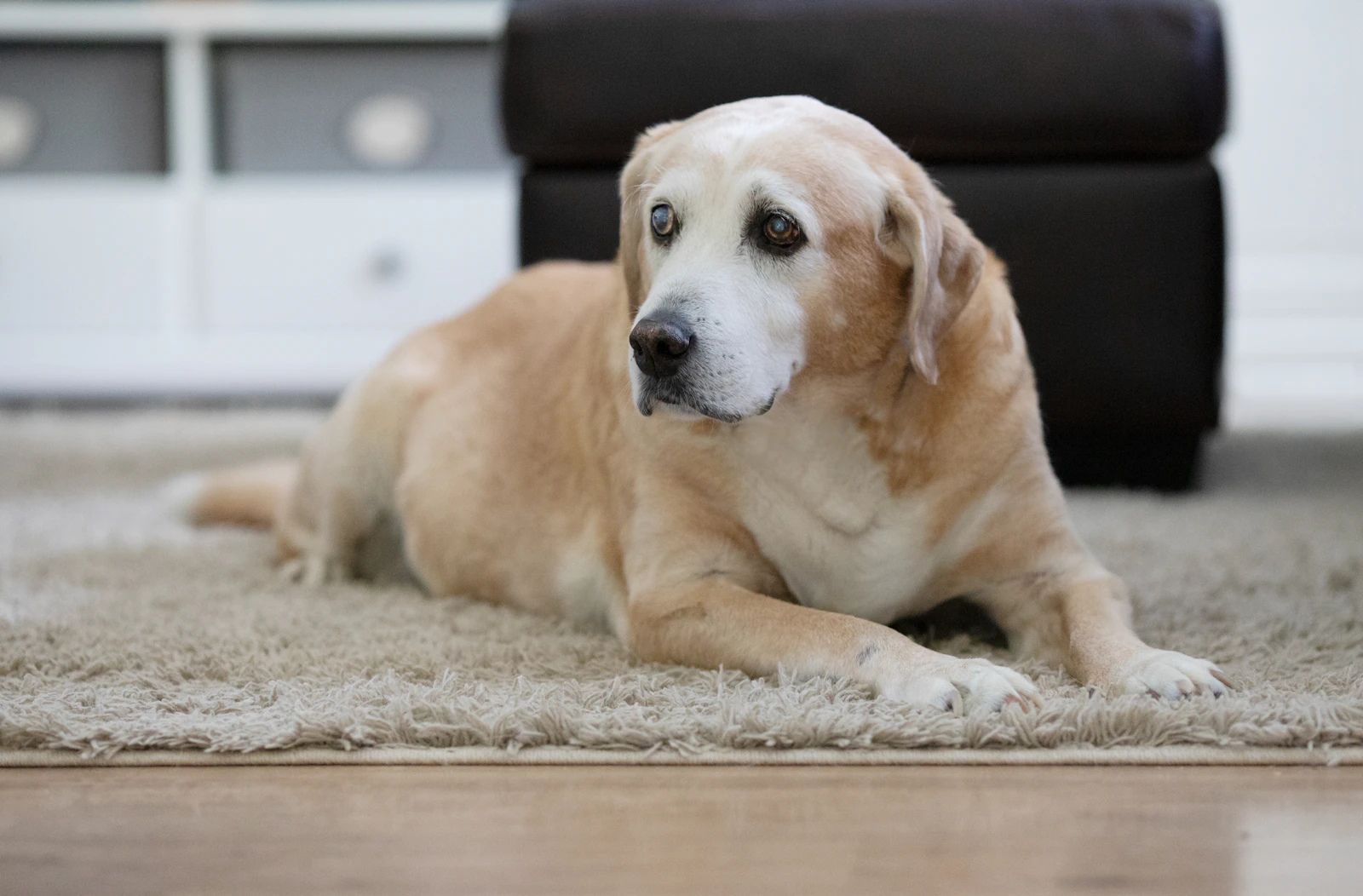
Librela Side Effects in Dogs: What the FDA Data Actually Says
By Sarah Bennett · Last updated August 16, 2026 · 14 min read
The short version: Librela side effects in dogs cluster into three groups: common and mild (lethargy, increased thirst and urination, vomiting), neurological (wobbliness, hind-end weakness, seizures), and a musculoskeletal signal involving accelerated joint damage. Zoetis pharmacovigilance data puts the overall adverse event rate at roughly 9.5 per 10,000 doses. An independent specialist analysis of European data found musculoskeletal events reported about nine times more often than for six comparison drugs. Both of those numbers can be true at once, and this guide explains why. If your dog is on Librela and becomes wobbly, weak in the back end, or suddenly much worse in a joint, that is a same-week phone call to your vet.
There is a specific kind of silence that follows a vet saying "there is a monthly injection we could try." You want the limping to stop. You have watched her think about the stairs before she takes them. And then you go home, type the drug name into a search bar, and land in a fight you did not know was happening.
That fight is real, and it has been running in peer-reviewed journals since late 2024. I write as a researcher, not a veterinarian: this guide lays out what the primary sources actually say, so you can walk into your next appointment with better questions.
What Side Effects Has the FDA Reported for Librela?
In December 2024, the FDA sent veterinarians a formal notice about what it was seeing. According to the FDA's Dear Veterinarian Letter, the events it identified and analyzed "include: ataxia, seizures, other neurologic signs, including but not limited to, paresis, recumbency, urinary incontinence; polyuria, and polydipsia." In plainer language: wobbliness, seizures, partial paralysis, an inability to get up, leaking urine, and a jump in drinking and peeing. The same letter notes that "In some cases, death (including euthanasia) was reported as an outcome of these adverse events."
Behind that letter sits a database. The FDA released its adverse drug event listing for Librela under a Freedom of Information Act request, and it covers reports received from May 5, 2023 through March 31, 2024. In that window there were 3,342 reports in dogs. The most frequently reported signs from that listing:
| Reported sign | Times reported |
|---|---|
| Lethargy | 404 |
| Increased thirst (polydipsia) | 373 |
| Increased urination (polyuria) | 359 |
| Vomiting | 316 |
| Diarrhea | 299 |
| Urinary incontinence | 237 |
| Death by euthanasia | 234 |
| Ataxia (wobbly, uncoordinated gait) | 232 |
| Seizure | 198 |
| Lack of efficacy | 187 |
| Urinary tract infection | 177 |
| Anorexia | 170 |
| Death | 151 |
| Limb weakness | 127 |
| Hind limb paresis | 107 |
| Proprioception deficit | 82 |
One entry deserves a specific mention. Urinary incontinence in dogs on Librela sits at 237 reports, and it is the sign most easily written off as an old dog simply having accidents. If leaking starts within weeks of a first injection, that timing is worth telling your vet rather than filing under old age.
Three things about that table matter more than the numbers themselves, and the FDA says all three in the same document.
First, the counts cannot be added together. More than one sign can be listed per report, so the FDA's ADE listing for Librela notes that "the Number of times reported column is not additive and does not necessarily represent the total number of reports received." The 234 euthanasia entries and the 151 death entries are not 385 separate dogs.
Second, a report is not a verdict. That same FDA listing states: "For any given ADE report, there is no certainty that the reported drug caused the adverse event."
Third, and this is the one almost nobody quotes: you cannot turn this table into a risk percentage. The same document says accumulated ADE reports "should not be used to calculate incidence rates or estimates of drug risk, because there is no accurate way to determine how many animals were actually given the drug". There is no denominator here. Anyone who hands you a percentage derived from this listing has invented it.
So the table tells you what has been reported, and it tells you nothing reliable about how often. For that, you need a different source.
How Common Are Librela Side Effects in Dogs?
The only party that knows the denominator is the company that sells the doses. Zoetis published its global pharmacovigilance data in Frontiers in Veterinary Science in April 2025, covering February 2021 through June 2024. In that period 18,102,535 doses were sold worldwide, with 17,162 adverse events reported in dogs, which the authors put at 9.48 events per 10,000 doses.
Within that, eight signs fell into the band the paper classifies as rare, meaning between 1 and 10 events per 10,000 doses. Lack of efficacy was the highest at 1.70, followed by increased thirst, ataxia, increased urination, loss of appetite, lethargy, death, and vomiting. Everything else came in below 1 per 10,000.
One detail from that paper deserves its own line, because it is about your dog specifically. The median age of dogs with a reported adverse event was 12 years, with an interquartile range of 10 to 13. This is a drug given to old dogs, and old dogs are already accumulating kidney changes, cognitive decline, and spinal disease on their own schedule. Separating "the drug did this" from "she is thirteen" is genuinely hard, and it cuts both ways: it can hide a real drug effect, and it can also make an unrelated decline look like one.
The honest caveat on the 9.48 figure is underreporting. Every passive surveillance system in medicine, human or veterinary, captures a fraction of what actually happens. A vet has to notice the event, connect it to the drug, and take the time to file. The true rate is higher than the reported rate. Nobody knows by how much.
Why Do Independent Specialists Report a Different Picture?
The numbers appear to contradict each other, and most articles simply pick a side.
In May 2025, a group led by veterinary surgeon Michael Farrell published an analysis in Frontiers in Veterinary Science using the European Medicines Agency's EudraVigilance database. Rather than asking "how often," they asked a comparative question: relative to six other drugs approved for the same purpose (Rimadyl, Metacam, Previcox, Onsior, Galliprant, and Daxocox), how often do musculoskeletal problems show up in Librela reports?
The answer was not subtle. Ligament and tendon injury, polyarthritis, fracture, musculoskeletal neoplasia, and septic arthritis were reported "~9-times more frequently" in Librela-treated dogs than in the combined total for all six comparator drugs. The team then had 19 suspected cases independently adjudicated, and an "18-member expert panel" unanimously concluded a strong suspicion of a causal association between bedinvetmab and accelerated joint destruction.
So which is it, 9.48 per 10,000 or nine times worse?
Both, because they measure different things:
| Zoetis pharmacovigilance | Farrell independent analysis | |
|---|---|---|
| Question asked | How many events per dose sold? | How does the pattern compare to similar drugs? |
| Data source | Zoetis global database | EMA EudraVigilance (2004 to 2024) |
| Denominator | 18.1 million doses | None; compares report ratios |
| Finding | 9.48 events per 10,000 doses | Musculoskeletal events ~9x the comparators |
| What it supports | Absolute risk to any one dog is low | The type of event is disproportionate |
| Main limitation | Passive reporting undercounts | Cannot establish incidence or causation |
A low absolute rate and a disproportionate signal are not in conflict. If a rare event is nine times more likely to be reported for one drug than for six alternatives combined, that is worth investigating even when the per-dose number stays small. Farrell's team stopped short of calling for withdrawal; their stated conclusion is that further investigation and close clinical monitoring are warranted.
It is also worth knowing that the FDA explicitly cautions against using adverse event data to compare the safety of different drugs, which is a live methodological objection to exactly this kind of comparison. Zoetis-affiliated researchers and independent specialists have gone back and forth on this in commentary papers through 2025. The debate is not settled. What has changed is that it is now happening in the open, in journals, rather than being absent from the conversation entirely.
What Is Rapidly Progressive Osteoarthritis, and Should You Worry?
This is the concern underneath the musculoskeletal numbers, and it has a name: rapidly progressive osteoarthritis, or RPOA. It means a joint deteriorating far faster than the natural course of arthritis would explain, with bone loss and collapse rather than gradual wear.
The proposed mechanism is uncomfortably intuitive. Librela works by neutralizing nerve growth factor, which blocks pain signaling. As a 2025 commentary in Frontiers in Veterinary Science describes it, the pathophysiology is thought to involve the suppression of pain signals, resulting in increased joint usage and subsequent structural damage. Pain is partly a brake. Release the brake on a damaged joint and the dog uses it more than the joint can bear.
There is a second layer that makes this more than theory. Nerve growth factor is not only a pain molecule; it also participates in bone and cartilage maintenance. Blocking it may do more than mute a signal.
The fact that reframes this whole discussion comes from a June 2026 review in the Journal of the American Veterinary Medical Association, led by veterinary surgeon Dirsko von Pfeil. Anti-NGF monoclonal antibodies were developed for humans first. In human trials, the same class of drug was associated with rapidly progressive osteoarthritis, and that association ultimately blocked regulatory approval for human use. The canine version was approved anyway. The authors argue that these events, while uncommon, are irreversible and often catastrophic, and can develop within months. (That paper sits behind a paywall, so this is a summary rather than a quotation; the mechanism and the concern are independently described in the freely readable commentary linked above.)
Two practical notes follow from this, and both are conversations to have rather than conclusions to act on alone:
- Concurrent NSAIDs. In human medicine the RPOA association was strongest when anti-NGF drugs were combined with NSAIDs. Whether that transfers to dogs is unresolved, but it is a reasonable thing to raise if your dog is on a daily NSAID and starting Librela.
- Lameness was in the original trials. In the European field study submitted for approval, lameness appears among the most common adverse reactions. It was on the label from the beginning.
None of this means a dog on Librela is heading for joint collapse. The events are uncommon by every available measure. It means that if a treated dog gets suddenly and dramatically worse in a specific joint, "the arthritis is just progressing" is not the only explanation available, and imaging is a reasonable ask.
How Long Do Librela Side Effects Last in Dogs?
This is the question I see asked most often, and it has an uncomfortable structural answer.
Librela is a monoclonal antibody given as a monthly injection. Unlike a daily tablet, there is nothing to stop. Once a dose is in, it stays in and continues to act for roughly the month it is designed to cover, and antibodies clear slowly. If your dog has a reaction in week one, you cannot undo the dose; you and your vet manage the symptoms and decide about the next one.
That single difference should shape how you approach a first injection. With an oral NSAID, a bad reaction means stopping tomorrow. With Librela, the commitment is longer, which is an argument for watching the first few weeks after a first dose more closely than you otherwise might.
The publicly available FDA documents do not include a breakdown of time-to-onset, so I am not going to give you a percentage for how many reactions happen in the first week. What the sources do support is the shape of the thing: reactions were reported across the dosing interval, and the drug's own duration sets the floor on how long an effect can persist.
Which Dogs Should Not Get Librela?
Some of this is written into the label, and some is judgment. The label contraindications are firm. Per the FDA-approved labeling on DailyMed, "LIBRELA should not be administered to dogs with known hypersensitivity to bedinvetmab" and "LIBRELA should not be used in breeding dogs or in pregnant or lactating dogs." The reasoning given is that antibodies of this class cross the placenta and enter milk, and that "Fetal abnormalities, increased rates of stillbirths and increased postpartum fetal mortality were noted in rodents and primates receiving anti-NGF monoclonal antibodies."
For the senior dogs this site is about, breeding status is rarely the issue. The judgment calls matter more, and Librela contraindications in dogs discussed at the clinic level usually center on one thing: existing neurological disease. A dog with degenerative myelopathy, disc disease, or lumbosacral stenosis already has a wobbly, weak back end. That is also the pattern most reported to the FDA. If a decline happens, distinguishing drug effect from disease progression becomes nearly impossible, which is a reason to establish a clear baseline before the first injection rather than a reason to refuse the drug outright.
One warning on the label is aimed at you rather than your dog. Pregnant women, women trying to conceive, and breastfeeding women are advised to take extreme care to avoid accidental self-injection. This applies to clinic staff handling the vial, but it is worth knowing.
What to Do If Your Dog Reacts to Librela
Call your vet the same week for any of these:
- A new wobble, stumble, crossing of the back legs, or knuckling over of a paw
- Sudden weakness in the hind end, or difficulty getting up
- A seizure of any kind
- New urinary incontinence, or a sharp increase in drinking and urinating
- One joint becoming dramatically worse over days to weeks rather than months
Then report it, because the surveillance system only works if people file. You can report to Zoetis at 1-888-963-8471, or directly to the FDA. When you do, the FDA asks for a full medical history, how many times the dog has received Librela, and the lot number on the vial. That last item is the one people never have, and it is worth photographing the vial or asking the clinic to note the lot in the record at every visit. It costs nothing and it is what makes a report traceable.
Filing a report casts no doubt on your vet. It is the only mechanism by which a pattern gets detected at all, and most of what is now known about this drug exists because someone filed.
How to Have the Librela Conversation With Your Vet
A note on where the information comes from. In November 2023 the FDA sent Zoetis a formal notice about its Librela professional website, stating that the site "makes false or misleading claims and representations about the efficacy of Librela" and that this "misbrands Librela" under federal law. The objection was to how efficacy graphs presented statistical significance. That does not make the drug ineffective, and Librela has helped a great many dogs. It does mean manufacturer marketing is not a neutral source, and it is a reason to ask your vet what they have seen in their own patients rather than what a brochure claims.
Useful questions:
- What is her baseline right now, before we start? Can we document gait and get films of the affected joint?
- She is on a daily NSAID. Do we continue it alongside Librela, and what is your thinking on that?
- She has a wobbly back end already. How will we tell drug effect from her spine getting worse?
- What would make you stop after one dose?
- What are the alternatives for her specifically?
On that last question, comparisons get asked a lot, and Librela vs Galliprant side effects is the most common pairing. They are different classes with different problems. Galliprant is a daily oral drug with a mostly gastrointestinal side effect profile that stops when you stop giving it. Librela is monthly, spares the gut, and carries the neurological and musculoskeletal signals described above with no way to withdraw a dose. Neither is strictly safer. They fail differently, and which failure mode you would rather manage is a real part of the decision. Our full guide to Librela covers efficacy, dosing, and cost, and there is a broader picture of managing arthritis at home and of joint supplements worth reading alongside it.
If Your Dog Has a Seizure While on Librela
Seizure and convulsion reports appear in post-approval safety data, and a seizure in an older dog is worth working up on its own terms rather than being written off as a drug effect. Dogs in this age group have other reasons to seize, and the workup for a first seizure in a senior dog is what separates them. Report the event to your vet and to the manufacturer, and expect bloodwork before anyone concludes anything about the injection.
Frequently Asked Questions
Does Librela have side effects? Yes. The most frequently reported are lethargy, increased thirst and urination, vomiting, diarrhea, and urinary incontinence. Less common but more serious reports involve neurological signs including ataxia, hind limb weakness, and seizures, plus a musculoskeletal signal involving accelerated joint damage.
How long do Librela side effects last? Librela is designed to work for about a month per injection, and monoclonal antibodies clear the body slowly. There is no way to withdraw a dose once given, so a reaction is managed rather than reversed, and the effect can persist across the dosing interval.
Will Librela side effects go away? Many of the milder reported effects, such as lethargy or vomiting, resolve. The concern with the musculoskeletal events described in the 2025 and 2026 literature is that accelerated joint destruction is structural and not reversible, which is why early recognition matters.
Is Librela safe for dogs? By the manufacturer's global data, adverse events were reported at roughly 9.48 per 10,000 doses, which is a low absolute rate. Independent specialists have found musculoskeletal events reported about nine times more often than for six comparison drugs and have called for closer monitoring. Both findings stand. Safety here is a risk-benefit decision made with your vet, not a settled yes or no.
Is Librela an NSAID? No. It is a monoclonal antibody that targets nerve growth factor, a completely different mechanism from NSAIDs like carprofen or meloxicam. This is why it avoids the gastrointestinal and kidney concerns of NSAIDs, and also why its risk profile looks nothing like theirs.
Can Librela be given every 3 weeks? The approved labeling is once monthly. Shortening the interval is off-label and a decision only your vet can make, and there is no published safety data supporting a three-week schedule.
The Practical Takeaway
Librela side effects in dogs are, by every available measure, uncommon. They are also, in a small number of cases, serious and irreversible, and the scientific community has not finished arguing about how often that happens or why.
You do not have to resolve that argument, and if reading this has you looking for something gentler instead, our guide to Librela alternatives for dogs is honest about which of those options can actually take its place. What you can do is smaller and more useful: get a clear picture of what your dog looks like before the first injection, know the specific signs that mean a phone call, and write down the lot number.
The next time she gets up from her bed, watch the first four steps. Not because you are expecting something to go wrong, but because in three months you will want to remember exactly what today looked like.
Sources
- FDA, Dear Veterinarian Letter notifying veterinarians about adverse events reported in dogs treated with Librela (bedinvetmab injection)
- FDA CVM, Librela (bedinvetmab) adverse drug event listing, FOIA release covering May 5, 2023 to March 31, 2024
- FDA CVM, Notice to Zoetis regarding Librela promotional communications, November 20, 2023 (NADA 141-562)
- Monteiro BP et al., Global pharmacovigilance reporting of the first monoclonal antibody for canine osteoarthritis, Frontiers in Veterinary Science, 2025
- Farrell M et al., Musculoskeletal adverse events in dogs receiving bedinvetmab (Librela), Frontiers in Veterinary Science, 2025
- Mobasheri A et al., Rapidly progressive osteoarthritis in companion animals treated with bedinvetmab, Frontiers in Veterinary Science, 2025
- DailyMed, LIBRELA (bedinvetmab injection) FDA-approved labeling
- von Pfeil DJF et al., Bedinvetmab (Librela/Beransa) in dogs raises safety concerns, including rapidly progressive osteoarthritis, and warrants vigilant adverse event reporting, Journal of the American Veterinary Medical Association, June 2026. DOI 10.2460/javma.26.03.0170 (paywalled)