Senior Labrador Health Problems
By Sarah Bennett · Last updated June 17, 2026 · 12 min read
Most of what threatens an aging Labrador can be traced back to one thing: the bowl. The breed that has topped America's popularity charts for decades is friendly, athletic, and famously, relentlessly hungry, and that hunger is not bad manners. In about one in four Labs it is written into a gene. The trouble is that a heavy Lab is a Lab whose every other senior problem gets worse: the weight lands on hips already prone to dysplasia, accelerates arthritis, raises the anesthetic and cancer risk, and shortens the life. So the single biggest lever you control in senior Labrador health problems is also the simplest, and the hardest, which is how much goes in the dish.
That is the thread running through this guide. We will cover the aging Labrador health issues that cluster in the breed, the conditions Labs face at higher rates than other dogs, the early signs, and the daily habits that matter, but the bowl keeps coming back because so much of the rest depends on it. We are not veterinarians; this is reported from peer-reviewed research, the AAHA senior-care guidelines, and breed work from Cambridge, the OFA, Michigan State, and Cornell, and it is not a substitute for an exam.
Why Labradors Have a Distinct Senior Health Profile
Three facts of Labrador biology shape how the breed ages. The first is size: a Lab carries 55 to 80 pounds through her hips and elbows for a dozen years or more, joints that are already, in this breed, more likely than average to be poorly formed. The second is that Labrador POMC gene obesity is real and documented: a 14-base-pair deletion in the POMC gene, identified at Cambridge in 2016, disrupts the signals that tell a dog she is full. It is carried by roughly 25% of pet Labradors and about 76% of those working as assistance dogs, and affected dogs are measurably hungrier. The "always starving" Lab is not greedy; she is genetically wired to feel unsatisfied. The third is that Labs run above the breed average for several cancers, which makes attentive senior surveillance worth the effort.
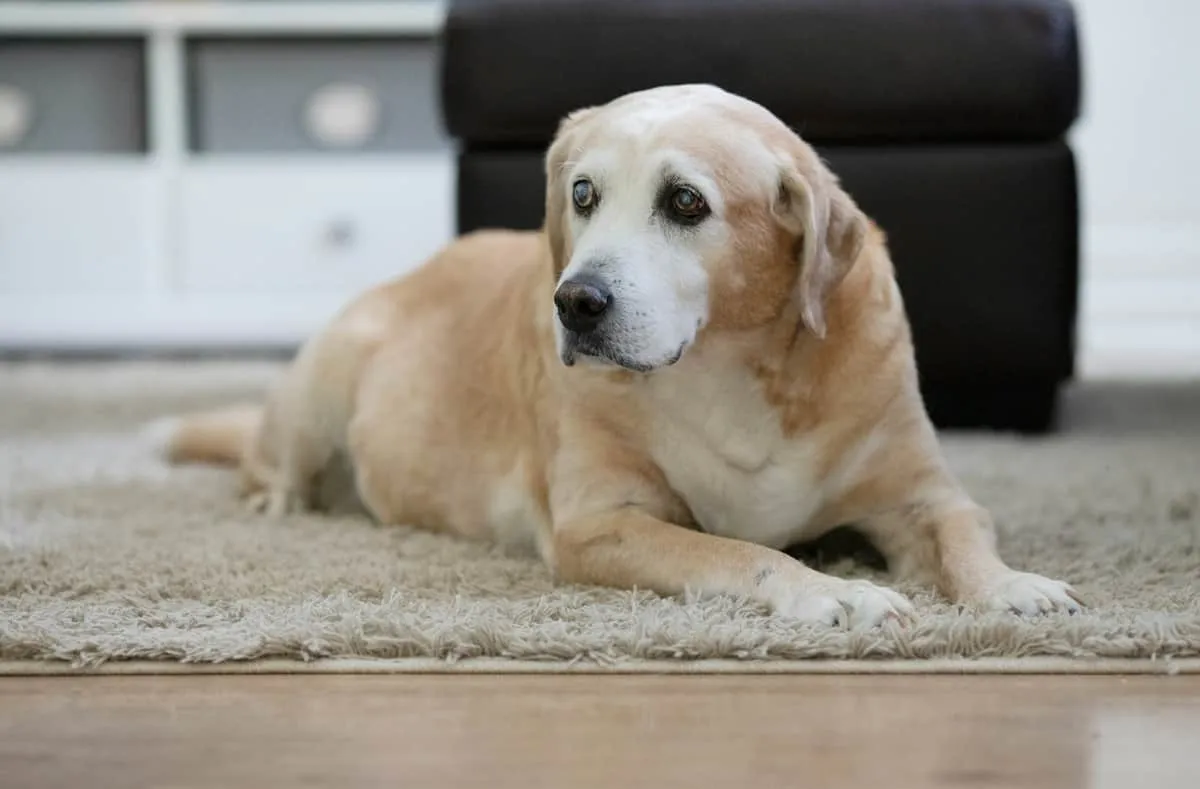
A Lab is generally considered senior around age 7, and her median lifespan is about 12 years, with many reaching 14 or 15 on careful weight control. One curious finding from a large UK study: chocolate Labs live a little shorter (median around 10.7 years, roughly 1.4 years less than yellow or black) for reasons still being studied. Across all of it, labrador lifespan health turns more on body condition than on almost anything else you manage at home.
The Most Common Senior Labrador Health Problems
In an old Lab, common diseases sort into a recognizable cluster, and the bowl is never far from the story.
The hunger, and the weight it drives
Start here, because it touches everything else. A POMC-positive Lab finishes her bowl in seconds, watches every bite you take, and gains weight on the rations that keep a littermate lean. You cannot train away a satiety gene, but you can out-manage it. The move is measured feeding, never free-feeding: a cup or a scale at every meal, a target body condition of 4 to 5 on the 9-point scale (a waist you can see from above, ribs you can feel under a light cover), and a weight-management senior food if she trends heavy. The reframe that helps most owners: the food drive is the lever, not the enemy. Slow-feeder bowls, puzzle feeders, and scatter-feeding turn that intensity into enrichment and stretch a measured portion into a satisfying event. If you want to know whether she is a carrier, genetic testing exists, but it changes only your guilt, not the plan, since measured feeding is right for every Lab.
Hips, elbows, and the arthritis they become
Hip dysplasia is the breed's signature orthopedic problem (the OFA reports around 12% in screened U.S. Labs, with some populations far higher), and it sets up the osteoarthritis that becomes most Labs' main source of chronic pain in old age. In a senior Lab, labrador hip dysplasia senior signs are quiet at first: a hesitation before the stairs or the car, a slowness to rise after a nap, a stiffness that eases once she warms up, less drive for the games she loved, and over time a wasting of muscle over the hindquarters. The most powerful treatment is the one from the section above, keeping her lean, paired with vet-guided multimodal pain control (often an NSAID plus gabapentin), joint supplements with real evidence, traction underfoot, and an orthopedic bed. Our at-home arthritis guide covers the full routine, and severe hips have good surgical options.
GOLPP (laryngeal paralysis)
This one is under-recognized and very much a Lab condition: the breed is the most commonly affected. What used to be called laryngeal paralysis is now understood as GOLPP, Geriatric Onset Laryngeal Paralysis Polyneuropathy, a progressive nerve disease. GOLPP labrador senior cases usually begin between 9 and 13 with a raspy, harsh sound on the in-breath, a change in the bark, and a dog who tires and overheats fast, then later add a hind-leg weakness as the wider neuropathy shows. The single most important management is heat avoidance, because a dog whose voice box does not open fully cannot pant to cool herself, so hot, humid days are genuinely dangerous. Weight control eases the breathing load, a surgical tie-back helps severe airways, and sudden respiratory distress in the heat is an emergency.
Cancer
Labs carry above-average rates of lymphoma, hemangiosarcoma, osteosarcoma, and mast cell tumors, so the realistic stance on labrador cancer rate senior is attentive, not anxious. A monthly hands-on check from nose to tail, catching new lumps, swollen lymph nodes, or a lump that grows or changes, plus annual senior bloodwork, is most of the defense. Two patterns deserve urgency: a sudden collapse with pale gums (which can signal a bleeding splenic hemangiosarcoma) is a same-day emergency, and a persistent lameness that does not respond to arthritis care, especially with a firm swelling on one leg, warrants ruling out osteosarcoma. Cancer is also the breed where the Golden Retriever's profile overlaps most; if you want the cancer-first deep dive, see our senior Golden Retriever guide.
Bloat (GDV)
Like other deep-chested large breeds, Labs are in the at-risk group for gastric dilatation-volvulus, where the stomach fills with gas and can twist. It is a true emergency: a hard, distended belly, repeated retching that brings nothing up, restlessness and drooling, then weakness. This is a same-day, get-to-the-nearest-vet-now event, and survival drops with every hour of delay. To lower the risk, feed smaller meals, avoid hard exercise right after eating, and ask your vet about a prophylactic gastropexy (tacking the stomach), which is often added during another abdominal surgery.
Hypothyroidism
Labs are above average for an underactive thyroid, which tends to arrive in middle to older age and is easy to mistake for ordinary slowing down: weight gain on the same food, low energy, a thinning or dull coat, skin that keeps getting infected, and seeking out warm spots. A thyroid panel at the annual senior visit confirms it, and a cheap daily pill (levothyroxine) usually returns a dog to her old self within a couple of months.
Early Signs Worth Catching
A Lab is stoic and food-driven enough to mask a lot. The drop-offs worth acting on:
- A new lump anywhere, evaluated, not watched
- Slower to rise, or hesitating at stairs and the car (hips and arthritis)
- Weight creeping up on unchanged food (often the thyroid, or just the gene winning)
- A raspy in-breath, a hoarse bark, or overheating fast (possible GOLPP)
- A sudden collapse, with pale gums (a same-day emergency; think splenic bleed)
- A food-obsessed Lab going off her dinner, which in this breed is more meaningful than in most; see senior dog won't eat
For a Lab over 8, annual bloodwork is the AAHA-recommended baseline; over 10, twice a year is often wiser.
Daily Habits That Prevent Senior Labrador Health Problems
- Measure every meal. The highest-leverage habit in the breed, and the one most often skipped.
- Keep exercise moderate and regular. Two easy walks beat one hard romp, and never push it in the heat, especially with any sign of a laryngeal change.
- Do a monthly body check. Nose to tail, every lump noted, because early-caught Lab cancers do far better.
- Run the annual senior panel. Bloodwork, urinalysis, and a thyroid check, with body condition scored honestly.
- Respect the heat. An older Lab, and any Lab with early GOLPP, does not cool the way she used to.
The Right Gear for a Senior Lab Household
Scale matters for a 70-pound dog:
- An XL orthopedic bed (44 inches or more, high-density foam, low entry) for a Lab to stretch out on
- A vehicle ramp rated well above her weight, to retire the jump that grinds an arthritic hip
- A rear-support harness for helping a big dog up
- Non-slip runners on hard floors, a real source of Lab hip injuries
- A slow-feeder bowl, which does double duty as enrichment and brake on a POMC-positive eater
Beyond the Cluster: Other Senior Lab Concerns
A few more worth keeping on the list: cataracts, common with age and sometimes correctable; cognitive decline, the canine dementia that spares no breed (see dog dementia symptoms); heart disease, less common in Labs than some breeds but worth a yearly listen; and the one that doubles as a warning sign, a food-motivated Lab losing her appetite, which is more telling in this breed than in almost any other.
Frequently Asked Questions
What are the most common senior Labrador health problems?
The Lab-specific cluster is hip and elbow dysplasia and the arthritis it leads to, gene-driven obesity, several common cancers, GOLPP (laryngeal paralysis), bloat (GDV), and hypothyroidism. Weight ties many of them together, which is why measured feeding is the single most useful habit in the breed.
Is the Lab POMC obesity gene really genetic?
Yes. The 14-base-pair POMC deletion was identified at the University of Cambridge in 2016, is carried by about 25% of pet Labradors (and around 76% of assistance Labs), and disrupts the neuropeptides that signal fullness, so affected dogs are genuinely hungrier. Genetic testing exists, but the management is the same either way: measured feeding, food puzzles, and portion control to a healthy body condition.
What is GOLPP, and why are Labs prone to it?
GOLPP (Geriatric Onset Laryngeal Paralysis Polyneuropathy) is the recognition that laryngeal paralysis in older dogs is usually one early sign of a broader, progressive nerve disease, and Labradors are the most affected breed. It tends to start at 9 to 13 with noisy breathing, a changed bark, and overheating, then adds hind-leg weakness. There is no cure, but heat avoidance, weight control, and surgery for severe airways all help.
How long do Labradors live?
Median Labrador lifespan is about 12 years, with many reaching 14 to 15 on good weight control. A large UK study found chocolate Labs live somewhat shorter (median around 10.7 years, roughly 1.4 years less than yellow or black) for reasons still under study. Body condition influences lifespan more than almost anything else an owner controls. The first drug built to extend large-breed lifespan is still working through approval, and we track where Loyal's longevity drug stands.
When does a Labrador become a senior?
Around age 7. Most vets treat 7-plus as the threshold for senior wellness, and the AAHA guidelines recommend annual senior bloodwork from age 8 in large breeds. See our when is a dog a senior guide for the size-by-size picture.
Sources
- Raffan E, et al. "A Deletion in the Canine POMC Gene Is Associated with Weight and Appetite in Obesity-Prone Labrador Retriever Dogs." Cell Metabolism, 2016. https://pmc.ncbi.nlm.nih.gov/articles/PMC4873617/
- University of Cambridge: POMC research news (2024). https://www.cam.ac.uk/research/news/genetic-mutation-in-a-quarter-of-all-labradors-hard-wires-them-for-obesity
- Orthopedic Foundation for Animals (OFA), hip dysplasia statistics. https://ofa.org/
- Michigan State University College of Veterinary Medicine, GOLPP research program. https://cvm.msu.edu/scs/research-initiatives/golpp/living-with-golpp
- 2023 AAHA Senior Care Guidelines for Dogs and Cats. https://www.aaha.org/resources/2023-aaha-senior-care-guidelines-for-dogs-and-cats/
- Cornell University Riney Canine Health Center, Laryngeal Paralysis. https://www.vet.cornell.edu/departments-centers-and-institutes/riney-canine-health-center/canine-health-topics/laryngeal-paralysis
Keep Reading
- Senior Golden Retriever Health Problems, the cancer-first large-breed profile
- Help an Old Dog with Arthritis at Home, the at-home framework for Lab joint pain
- Best Joint Supplements for Senior Dogs, evidence-supported supplementation
- Best Food for Senior Dogs, weight-management formulas for a POMC-positive Lab
- Senior Dog Won't Eat, why lost appetite means more in a food-driven breed
About the authors
Sarah Bennett writes about senior dog care from a household centered on her Border Collie, Lucy. Researching the Labrador, the thing that reframed it for her was the bowl: so much of the breed's senior trouble runs through a single, genetically loaded relationship with food, which makes the simplest habit, measuring the meals, the most powerful one. She is not a veterinarian; her work is reported, sourced from veterinary and breed-health research, and reviewed against published guidelines.
Leo Bennett is the co-author of Senior Dog Daily and Sarah's husband. The pair share research and writing duties on the site.
Senior Labrador health problems are, more than in most breeds, downstream of one number: her weight. Get the bowl right and you take pressure off the hips, the heart, the surgery table, and the years ahead. An owner who measures the meals and watches for the lump has already done the two highest-leverage things a Lab's old age asks of her.