
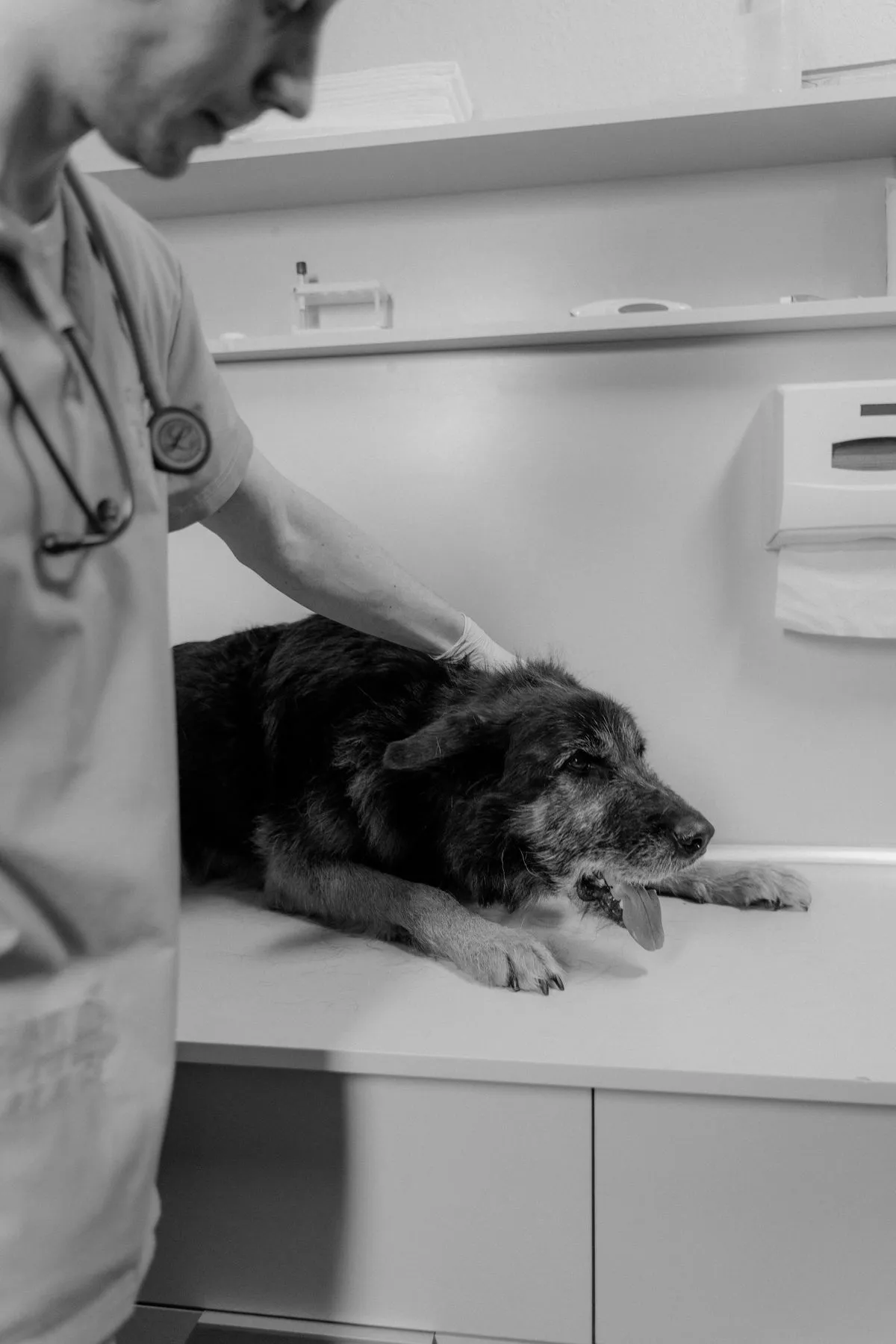
Is Anesthesia Safe for a Senior Dog?
By Sarah Bennett · Last updated July 31, 2026 · 11 min read
The short version: For most senior dogs, anesthesia is safe, and the reason is the one owners most often get backwards: age itself is not a disease. What raises anesthetic risk is a dog's underlying health, not the number on her chart, and that is exactly what a vet checks before she ever goes under. In the largest study of its kind, the risk of an anesthesia-related death was about 0.05% in healthy dogs, roughly 1 in 2,000. The real question is not "is she too old," but "how healthy is she, and is this procedure worth doing." Skipping a needed dental cleaning purely out of age-fear often does more harm than the anesthesia would.
Almost every owner of an aging dog meets this fear at some point. The vet recommends a dental cleaning, or finds a lump that needs removing, and the room goes quiet at one word: anesthesia. The worry is real and it is loving, but it usually rests on a misunderstanding. So the answer to whether anesthesia is safe for senior dogs starts by separating age from health, because they are not the same thing. I write as a researcher and owner, not a veterinarian, and none of this replaces a conversation with yours. This guide covers the real dog anesthesia death rate, why the pre-anesthetic blood test for a senior dog matters more than her age, what a senior dog dental cleaning under anesthesia actually involves, why anesthesia free dog teeth cleaning is not the safe shortcut it sounds like, and what senior dog anesthesia recovery looks like.
Is Anesthesia Safe for Senior Dogs?
For a reasonably healthy older dog, yes. Modern veterinary anesthesia is a monitored, individualized process, and the numbers are more reassuring than the fear suggests. The landmark study on this is the Confidential Enquiry into Perioperative Small Animal Fatalities (CEPSAF), which tracked 98,036 anesthetized dogs. It found the overall risk of an anesthetic or sedation-related death was about 0.17% in dogs, and, split by health status, about 0.05% in healthy dogs (1 in 1,849) and about 1.33% in sick dogs. Those numbers come from UK practices between 2002 and 2004, so they are the floor rather than the ceiling of what monitoring can do today; the authors already concluded then that small animal anesthesia was becoming safer.
That split is the whole story. A healthy senior carries a low risk that looks a lot like a healthy younger dog's. A dog with significant underlying disease carries a meaningfully higher one. Age nudges a dog toward the second group only to the extent that it brings other conditions with it, and the job of the pre-anesthetic workup is to find out which group your dog is actually in.
Why Age Is Not the Real Risk
Vets have a saying worth borrowing: age is not a disease, the same principle that shapes whether an older dog still needs yearly vaccines. An eleven-year-old dog with clean bloodwork, a sound heart, and good organ function is not a high anesthetic risk simply for being eleven. What actually matters is her physiology, and aging changes that in ways a good anesthetic plan accounts for:
- Less organ reserve. Older kidneys and livers clear anesthetic drugs more slowly, so doses are lowered and drug choices adjusted.
- A smaller cardiac cushion. An aging heart tolerates swings in blood pressure less easily, which is one reason monitoring and IV fluids matter.
- Harder time holding temperature. Seniors lose body heat under anesthesia faster, so warming support is part of the plan.
- Hidden conditions. Early kidney or heart disease can be present with no outward signs at all.
That last point is why bloodwork before anesthesia is not an upsell. A pre-anesthetic panel can catch the subclinical kidney or liver trouble that would change which drugs are safe, before it becomes a problem on the table. It is the same organ-function picture we describe in our guide to senior dog bloodwork, used here to build a safer plan.
What Actually Raises the Risk
If age is not the driver, these are. Vets grade a patient's baseline health on a scale (the ASA physical status score), and the higher the burden of disease, the higher the anesthetic risk climbs.
- Existing heart disease, which affects how the body handles blood pressure and fluids under anesthesia.
- Kidney or liver disease, which slows the clearance of anesthetic drugs.
- Obesity, which complicates breathing, drug dosing, and recovery.
- Uncontrolled conditions like diabetes or Cushing's that are not yet stable.
- A flat-faced (brachycephalic) airway, which needs extra care around induction and recovery.
- The procedure itself, since a long, complex, or emergency surgery carries more risk than a short, planned one.
None of these is an automatic "no." Each is a reason for a more careful plan, and most are things a vet would rather know about and manage than be surprised by.
How Vets Make Anesthesia Safer for a Senior Dog
Anesthesia in 2026 is not one drug and a held breath. The standards laid out in the 2020 AAHA Anesthesia and Monitoring Guidelines describe a whole system built around keeping a patient stable, and it applies especially to seniors:
- A pre-anesthetic exam and bloodwork to assess organ function and tailor the plan to the individual dog.
- An individualized, balanced protocol, often combining several drugs at lower doses (multimodal anesthesia) rather than a large dose of one, which is gentler on an older body.
- Continuous monitoring through the procedure: heart rate and rhythm (ECG), blood pressure, blood oxygen (pulse oximetry), exhaled carbon dioxide (capnography), and body temperature.
- IV fluids and a placed catheter, to support blood pressure and give instant access if a drug is needed.
- Warming support to hold body temperature, since hypothermia slows recovery.
- Monitored recovery, because the period after anesthesia is when many complications appear. This is the part of CEPSAF worth carrying into the appointment: 47% of the anesthesia-related deaths in dogs happened after the procedure, not during it, and the study's own conclusion was that better postoperative care could reduce fatalities.
A dog with a known condition may also get a referral to a specialist or a board-certified anesthesiologist for the procedure. The point of all of it is the same: the risk is managed, not left to chance.
The Dental Dilemma: Anesthesia vs "Anesthesia-Free"
The age-fear does its quietest harm at the dentist. Dental disease is nearly universal in senior dogs, and a proper cleaning requires general anesthesia. Faced with that, many owners reach for what sounds like the safer option: "anesthesia-free" dental cleaning, often offered at grooming salons.
The trouble is that it treats the wrong problem. The American Veterinary Dental College advises against anesthesia-free dentistry, because scraping the visible surface of a tooth does nothing about the disease that lives below the gumline, where periodontal infection actually does its damage. It makes teeth look cleaner while leaving the painful, body-taxing disease in place, and the restraint it requires can be stressful and unsafe in its own right. For a senior dog, an untreated mouth is not a small thing: chronic dental infection burdens the heart and kidneys. Weighed against that, a monitored anesthetic cleaning is very often the lower-risk choice. Our guides to senior dog dental care and the best dental products for senior dogs cover what helps between cleanings.
Questions to Ask Your Vet Before Anesthesia
You are allowed to ask for the plan. A good vet will welcome it. Bringing these to the appointment turns a scary unknown into a shared decision, and our senior dog vet visit guide has more on preparing:
- What did her pre-anesthetic bloodwork show, and does anything change the plan?
- How will she be monitored during the procedure, and who is watching her?
- Will she be on IV fluids and kept warm?
- What is her specific risk given her health, not just her age?
- Who watches her while she comes round, and for how long after she wakes up?
- What does recovery look like, and what should I watch for at home?
- Is this procedure worth doing now, and what happens if we wait?
When the Answer Is to Weigh It Carefully
Not every dog is a straightforward yes, and pretending otherwise would not help you. A dog with advanced heart disease, late-stage kidney failure, or a poor quality of life is a genuinely different conversation, and an elective procedure may not be worth the risk for her. At that point the decision stops being about anesthesia alone and becomes about the whole dog: what the procedure buys her, how she is doing overall, and what you are protecting. Our quality of life scale can help frame that when it is a hard one. The goal is never to be talked into a procedure or out of one, but to make the call with clear eyes, alongside a vet who knows her.
Is Anesthesia Safe for Senior Dogs? Frequently Asked Questions
Is anesthesia safe for senior dogs? For most reasonably healthy senior dogs, yes. Anesthetic risk is driven by a dog's underlying health, not her age. In the large CEPSAF study, the risk of an anesthesia-related death was about 0.05% in healthy dogs, roughly 1 in 2,000, rising in dogs with significant disease. A pre-anesthetic exam and bloodwork let a vet assess your dog's real risk and tailor a safer plan.
Is my dog too old for anesthesia? Age alone rarely makes a dog "too old" for anesthesia. What matters is her health: heart, kidney, and liver function, and any uncontrolled conditions. Many dogs safely undergo anesthesia well into their senior and geriatric years. The right question is not her age but her health status, which bloodwork and an exam reveal.
What is the death rate for dog anesthesia? The largest study (CEPSAF, 98,036 dogs) found an overall anesthesia and sedation-related death risk of about 0.17% in dogs, about 0.05% in healthy dogs, and about 1.33% in sick dogs. In other words, health status changes the risk far more than any single number captures, which is why an individual assessment matters.
Should I get a dental cleaning for my senior dog under anesthesia? Usually yes, if your vet recommends it. Dental disease is common and painful in seniors and burdens the heart and kidneys, and a proper cleaning needs anesthesia to reach below the gumline. "Anesthesia-free" cleaning only polishes the visible surface and is discouraged by veterinary dentists. A monitored anesthetic cleaning is often the lower-risk choice for the whole dog.
How long does it take a senior dog to recover from anesthesia? Most dogs are alert within a few hours and back to themselves within 24 to 48 hours, though older dogs can be groggy or wobbly a little longer as their bodies clear the drugs. Follow your vet's aftercare instructions, keep her warm, quiet, and hydrated, and call the clinic if she is very hard to rouse, will not eat by the next day, or seems in pain.
Sources
- Brodbelt DC, et al. The risk of death: the Confidential Enquiry into Perioperative Small Animal Fatalities (CEPSAF). Veterinary Anaesthesia and Analgesia, 2008;35(5):365-373. Overall dog risk about 0.17%, about 0.05% in healthy dogs and 1.33% in sick dogs. https://pubmed.ncbi.nlm.nih.gov/18466167/
- American Animal Hospital Association (AAHA): 2020 Anesthesia and Monitoring Guidelines for Dogs and Cats. https://www.aaha.org/resources/2020-aaha-anesthesia-and-monitoring-guidelines-for-dogs-and-cats/
- American Veterinary Medical Association (JAVMA News): Below the surface of anesthesia-free dentistry, on the AVDC position and why subgingival disease cannot be reached without anesthesia. https://www.avma.org/javma-news/2016-02-01/below-surface-anesthesia-free-dentistry
- American Kennel Club: Why veterinary dental procedures are recommended over anesthetic-free procedures. https://www.akc.org/expert-advice/health/anesthetic-free-dental-procedures-for-dogs/
One genetic question is worth raising before any sedation in a herding breed or a mixed-breed dog of unknown ancestry: whether she carries the MDR1 mutation, which changes the dosing of several sedatives and anti-nausea drugs used around anesthesia. It is a one-time test and the answer never expires.
Keep Reading
- Senior Dog Bloodwork, what the pre-anesthetic panel is checking and why
- Senior Dog Dental Care, the home-and-vet routine that reduces how often she needs a cleaning
- Senior Dog Vet Visit Prep, how to walk in with the right questions
- The Quality of Life Scale, for weighing a bigger procedure in a frailer dog
About the authors
Senior Dog Daily is written by Sarah Bennett and Leo Bennett, a husband-and-wife team who research senior care from a home built around their Border Collie, Lucy. Neither of us is a veterinarian. We read veterinary guidance and turn it into plain, practical explanations, with the claims traceable to the sources above. If a vet you trust has recommended a procedure, let the fear of anesthesia be a reason to ask better questions, not a reason to say no on your dog's behalf.